

Whole house water filtration in Houston targets the things you notice at every tap: chlorine taste, disinfectant odor and grit in the aerators. A filter goes on the main line and treats all the water entering the home. It will not remove hardness, and a drinking water system at one sink may suit you better. Start by naming the problem.
What does whole house water filtration in Houston actually fix?
It fixes taste, odor and particles at every tap. The City's main sources are lake water from the San Jacinto and Trinity rivers, treated and disinfected for the trip through the pipes. A summary of the City's 2025 report lists the Main System on chloramines, and EPA says water that meets its standards is safe for household use. For most homeowners, filtration is about taste, smell and comfort.
Here is what a filter tends to help with and what it leaves alone:
- Usually helps: chlorine taste and odor, sediment and grit
- Sometimes helps: seasonal earthy tastes, which University of Arkansas guidance says carbon does not control for some surface water algae
- Does not help: hardness, scale and spots, which need a water softener
Seasonal taste shifts trace to algae in the lakes, the City says, and its water continues to meet the rules. City leak reports also rose from 9,143 in 2020 to 13,911 in 2023, according to ABC13, citing Houston Public Works, and main repairs can stir up grit.
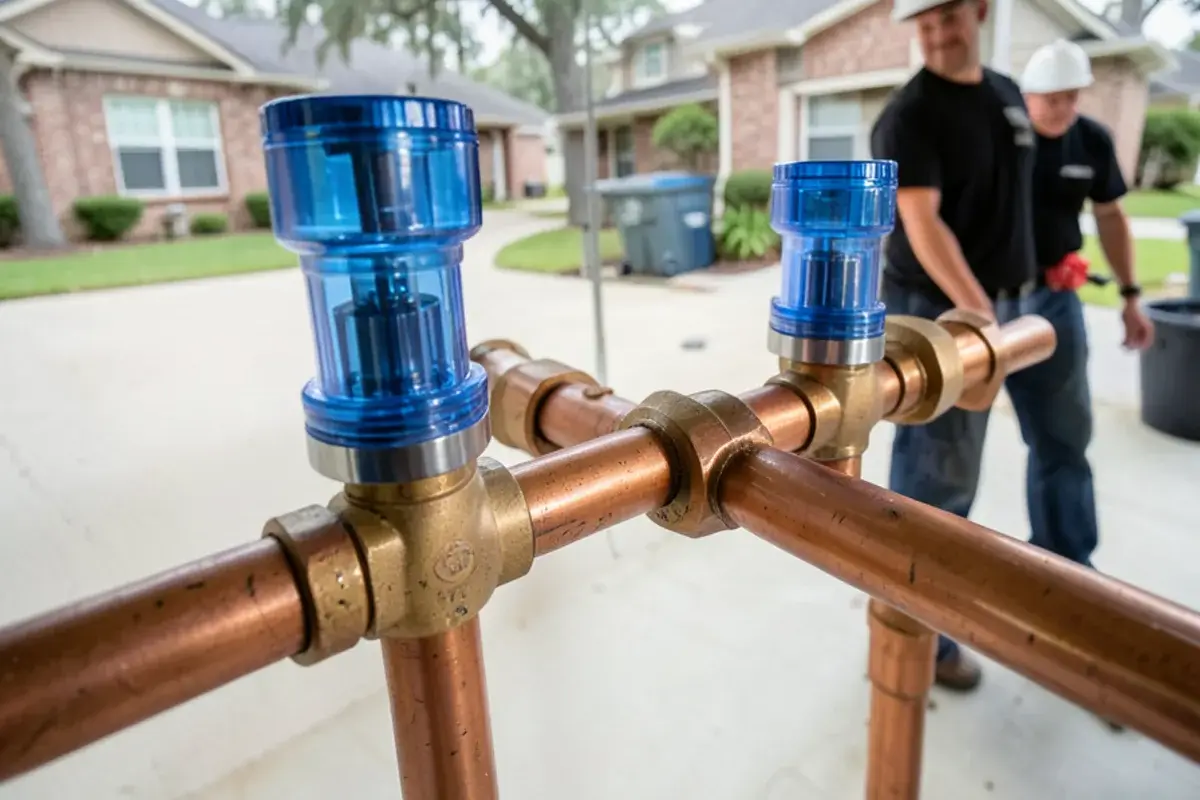
Chlorine smell or grit at the tap? Call and we'll help you sort out which filter fits.
- ★ 5.0 on Google, 18 reviews
- Sun–Thu 7 AM–8 PM · Fri 7 AM–6 PM · Sat closed
- Clear, upfront quote
Whole home filter, drinking water filter or reverse osmosis install?
Choose by where you want the change. Here is how the three main setups compare:
| Setup | Treats | Best for | Trade-off |
|---|---|---|---|
| Whole home filter | All water entering the house | Showers, laundry, every tap | More media, must match house flow |
| Drinking water filter | One sink | Taste at the kitchen tap | Rest of the home unchanged |
| Reverse osmosis | One sink, usually | Lowest dissolved solids at the tap | Waste water, a tank, membrane upkeep |
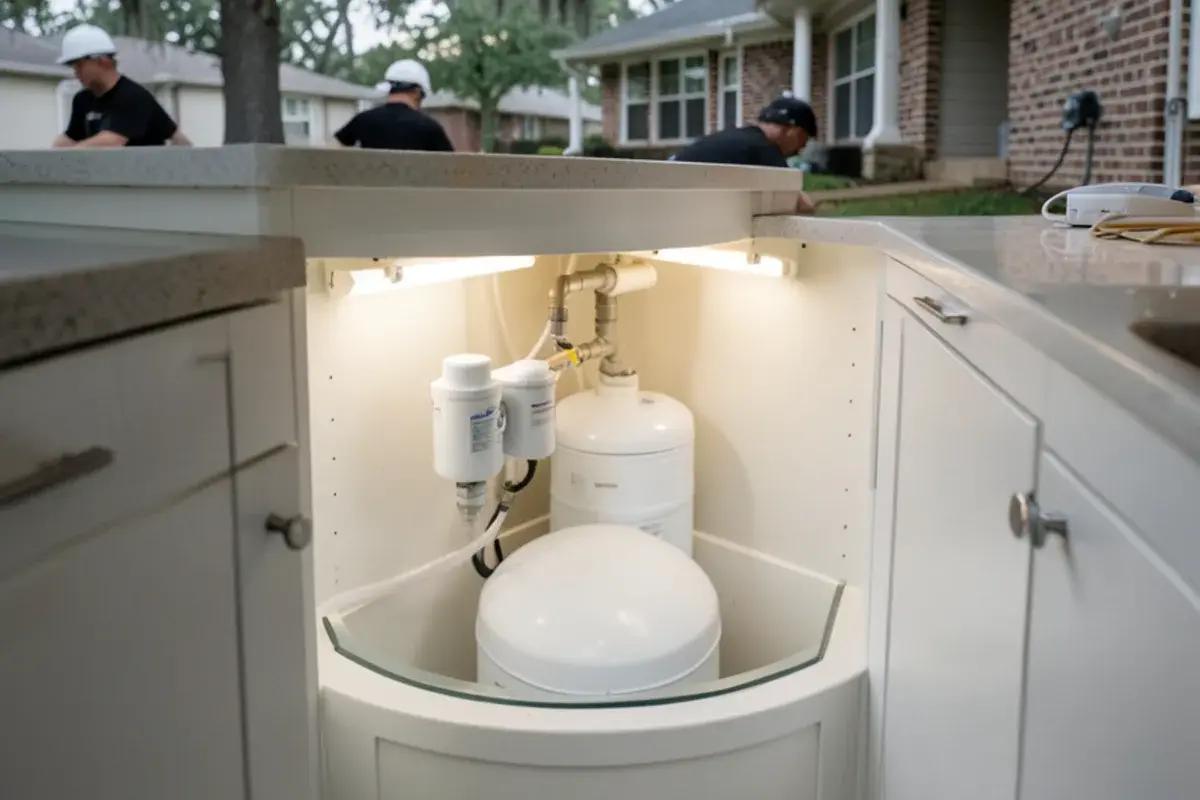
A reverse osmosis install is the most involved of the three at the sink. University of Arkansas guidance describes water pushed through a thin membrane, with impurities rinsed away by some waste water, and a small reservoir under the counter. It also warns that RO membranes need clean water to last, so pretreatment is common. Some membranes will not tolerate hardness or chlorine.
How do you read a filter's NSF/ANSI listing?
Read the standard and the named contaminant, not just the logo. NSF notes that the numbers are not a ranking. They reflect the order the standards were developed.
- NSF/ANSI 42: aesthetic effects such as chlorine taste and odor
- NSF/ANSI 53: certain contaminants with listed reduction claims
- NSF/ANSI 58: reverse osmosis systems
- NSF/ANSI 401: selected emerging compounds
- NSF/ANSI 44: softeners, listed here for comparison
A listing applies to a specific model and a specific claim. Check that the exact model appears in the certifier's database, and that the claim matches your concern. We cover what a system does in plain terms, and we do not make health claims for any filter.
Sizing a filter for flow, pressure and cartridge life
A whole house filter has to keep up with the whole house. An undersized housing shows up as weak showers when the washer runs. Three numbers guide the choice:
- Flow rate: rated gallons a minute against your peak household use
- Pipe size: a 3/4-inch or 1-inch main needs matching ports
- Capacity: rated gallons of media life before a change
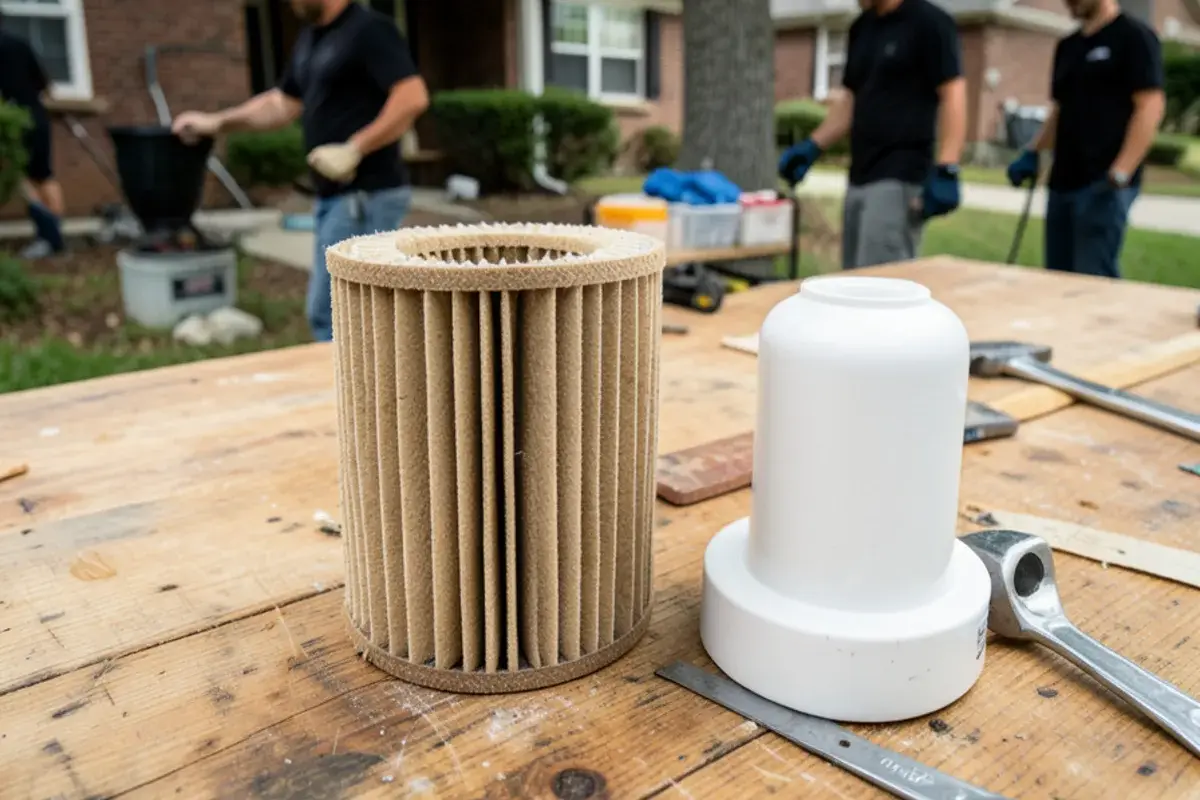
A two-stage setup puts a sediment stage ahead of the carbon, so grit does not clog the more expensive media. NDSU Extension says a 15-micron sediment filter should do for rust or iron on a public supply, and that finer filters need more pressure to push water through. Activated carbon also has a limit, and University of Arkansas guidance says it must be replaced once its capacity is used up.
Where a softener is also in the plan, the usual order is sediment, then carbon, then softener, then water heater. Reverse osmosis goes last, at the sink.
What a water filter installation involves, step by step
The sequence is simple, and each step answers a question about your house:
- Tell us the problem you notice, and which tap or room it affects.
- We read your utility's report and test the water if needed.
- We pick the location on the main line or under the sink.
- You see a clear, upfront quote for the system and any pipe changes.
- We shut off the water and fit the housings with a bypass and shut-off valves.
- We flush the media, check leaks and pressure, and show you the cartridge change.
Most Houston main lines come up at an exterior wall or the garage on a slab home, so that is the usual spot for a whole home unit.
What a filter install includes
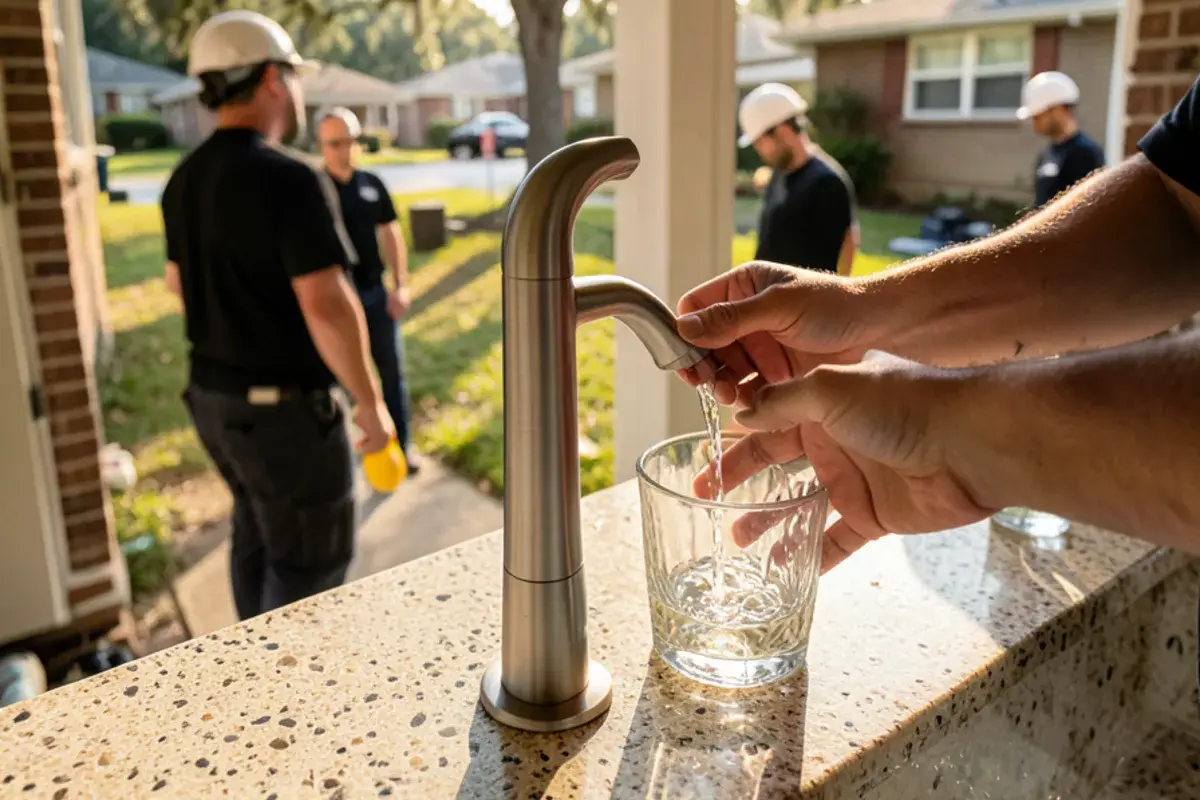
A whole house job covers the housings, the valves around them and a bypass, so water stays on while cartridges change. An under-sink job covers the system, the faucet, the tie-in to the cold line and, for reverse osmosis, the drain connection. Either way, the work starts from your complaint, because a sediment stage does nothing for odor and carbon does nothing for hardness.
Whole house setups have details worth planning. The Minnesota Department of Health says they are typically installed in pairs and usually leave out outdoor faucets. It also notes that water runs unfiltered while the bypass is open. Housings need clearance below for a cartridge to drop out, so the spot on the wall matters as much as the pipe. A reverse osmosis job also has to find room under the sink for the reservoir, and the feed water may need pretreatment first.
This work includes:
- A review of your water report and symptoms
- Selection of a listed system for your problem
- Housing, valves and bypass connections
- A leak and pressure check
- A walkthrough of cartridge changes
What sets the cost of a filtration system?
Scope sets the price, so we look at the job and then quote it. Factors include:
- Whole home or single tap: main line or under the sink
- Stages: sediment, carbon or both
- Media type: ordinary carbon, or a type rated for chloramine
- Plumbing: a ready spot, or new valves and bypass
- Ongoing supplies: cartridges and membranes over the years
Filter costs keep going after the install, so ask what a year of cartridges or membranes runs on your system. A larger housing holds more media and may stretch the change interval. A main at an open garage wall is simpler than one that needs new pipe to reach a free spot.
Water use sets the yearly number. The Minnesota Department of Health says carbon can last several years at low use and needs changing sooner at higher use, so a family of five pays for media faster than a couple. A paired setup means more cartridges at each change. Catalytic carbon for chloramine is a different product from plain carbon, so confirm which one the quote names. Reverse osmosis adds a membrane and any prefilters to that list. The same agency says it can create a lot of wastewater, which shows up on the water bill.
Who regulates filter installs in Texas?
Texas State Board of Plumbing Examiners licenses cover plumbers here, and TCEQ licenses water treatment specialists. Find out which license applies to your installer. Occupations Code 1301.053 exempts water treatment installs from the plumbing license itself, but state law or city ordinance can still require inspection. Inside Houston, ask the Houston Permitting Center whether your job needs a permit.
Problems with the supply itself go to your utility first. Galena Park, for one, asks residents to report rusty water so the mains can be flushed, and no home filter replaces that call. EPA sets the standards a public system has to meet.
Looking after your chlorine filter and RO membrane
Change media on schedule, because a cartridge past its rating stops doing its job. NDSU Extension calls any stated carbon life an estimate and suggests three to six months for high-volume units. Note the install date. Watch for falling pressure. A carbon filter left unused for more than five days can feed bacteria, NDSU warns, so run the water after a trip. Shut the bypass correctly when you change cartridges, and flush new media before use. After a City main repair in your street, check your sediment stage. If a faucet aerator clogs repeatedly or a valve starts leaking, faucet repair may be the fix.
Why PipeElectric for water filtration?
Filter claims get confusing quickly, so straight answers help:
- PipeElectric holds 5.0 on Google with 18 reviews.
- Customers mention plain explanations and clean work.
- Reviews also mention fair pricing.
- The setup you choose comes with a clear, upfront quote.
Saturday is the one closed day. Every other day opens at 7 AM and closes at 8 PM, or 6 PM on Friday. Have your utility's report handy, plus any cartridge numbers from a system you already own. Ask for the model and its listing on the quote, so you can check both yourself.
We work on filtration across Houston and nearby communities, including Bellaire, Pearland, League City and Humble.
What customers say about our plumbing work
5.0 on Google from 18 reviews, checked October 2026.
“The plumbers were very professional and made sure I understood what was going on during the entire process. Their prices are very reasonable as well.”
“They had someone out to my house within a couple of hours. The technician was professional, he explained everything clearly, located the gas leak, and repaired it on the spot. He even double check the rest of the line to make sure there wasn't any other leak. I really appreciated how honest and thorough they were.I highly recommend PipeElectric to anyone looking for fast, affortable and caring service!”
“Had PipeElectric install a new water heater, and they did a fantastic job! Fast, professional, and no mess left behind. Highly recommend them for any plumbing work!”
Whole House Water Filtration around Houston
- Bellaire · Wells supply about half the water here, so taste can differ from Houston's lake-fed surface supply.
- Pearland · Pearland's own surface water plant began pumping in October 2024, so recent taste changes may trace there.
- League City · Most supply comes from Houston's Southeast plant, with wells capped near 10%, so filter for surface water taste.
- Humble · Well water and Houston surface water both reach Humble taps, so name the taste before picking media.
- Galena Park · Iron and manganese cause rusty water here; report it to the city, then consider a sediment stage.
- Rosenberg · Since June 2018 city water has used chloramines, so look for a listing that names them.
- Baytown · The 2022 report lists chloramines at 1.30 to 6.00 ppm, so match media to that disinfectant.
- Kingwood · Free chlorine, not chloramine, is listed for Kingwood, so plain carbon may suit better than catalytic media.
Whole House Water Filtration questions
Do I need a whole house filter or just a drinking water filter?
It depends on where you notice the problem. If chlorine smell in the shower or grit at every faucet bothers you, a whole house unit makes sense. If you only care about the water you drink and cook with, an under-sink filter costs less to run and changes less plumbing.
Will a filter get rid of the seasonal earthy taste in Houston water?
Not always. The City attributes seasonal taste and odor changes to byproducts of naturally occurring algae in its lakes. University of Arkansas guidance says activated carbon helps with many tastes, but it does not control those from some surface water algae. Expect an improvement, not a promise, and read the listing.
Does a chlorine filter work on chloramine?
Do not assume so. A summary of the City's 2025 report lists the Main System on chloramines, and NDSU Extension describes catalytic carbon as the form designed for them. Look for a product whose listing names chloramine reduction specifically. Some areas served by wells use free chlorine, so check your own report.
How often do filter cartridges need changing?
Follow the rated gallons or months on the cartridge, whichever comes first. Grit-heavy water loads a sediment stage sooner, and a pressure drop at the shower is the usual sign. Mark the date on the housing. A worn-out carbon stage stops doing its job, and it gives you no warning.
Does a whole house filter replace a water softener?
No, the two do different jobs. Filters handle taste, odor and particles, and hardness minerals pass through. If scale is the complaint, you want a softener. When a home has both, the filter usually goes first, so sediment and disinfectant reach the softener in smaller amounts.
Can a home filter replace following a boil water notice?
No. Follow the City's instructions when a notice is issued, as Houston residents did during the February 2021 freeze, whatever filter you have. Typical home filters are not rated as an alternative to boiling. After a notice lifts, follow the maker's steps for flushing the system and changing cartridges.
Chlorine smell in the shower or grit in the aerators? Call and describe it.
- ★ 5.0 on Google, 18 reviews
- Sun–Thu 7 AM–8 PM · Fri 7 AM–6 PM · Sat closed
- Clear, upfront quote
PipeElectric - Plumbing & Electrical - HVAC · Houston, TX · (321) 559-0657