
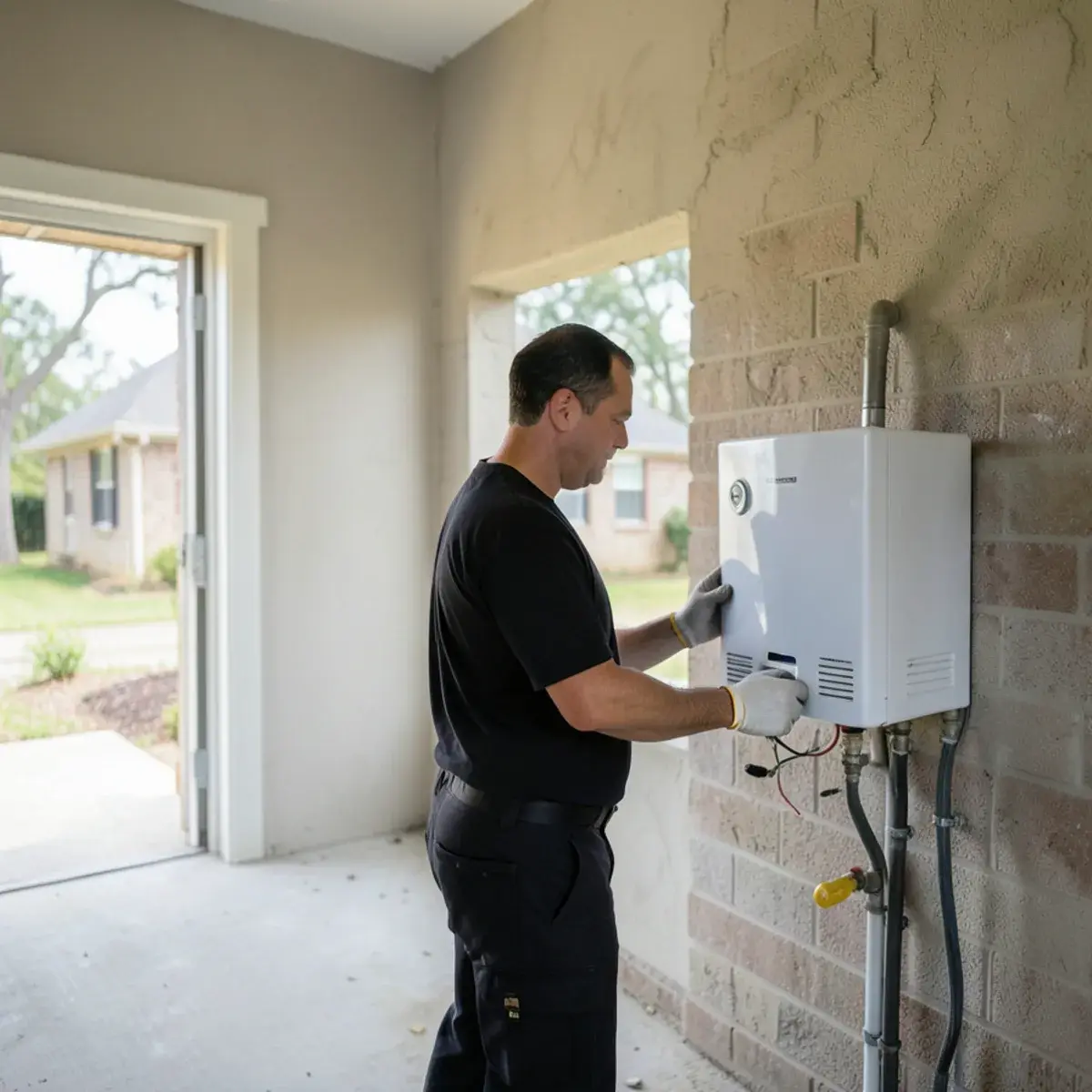
Tankless water heaters in Houston work well when the unit is sized for your busiest moment and the house can feed it. That means enough gas or electric capacity, a vent path, and a plan for hard water scale. They heat on demand, so output depends on flow and temperature rise. A tankless is not a simple tank swap.
Tankless vs tank: what changes in a Houston home?
Tankless trades stored hot water for on-demand heating, and that shifts the plumbing work upfront. Here is how the two compare:
| Tank | Tankless | |
|---|---|---|
| Hot water supply | Stored, limited by gallons | Continuous, limited by flow |
| Life, per Department of Energy | 10-15 years | Can pass 20 years |
| Efficiency | Standby loss from stored water | 24-34% better at 41 gallons a day or less, 8-14% at about 86 |
| Gas demand | Modest | Large, may need a bigger line |
| Scale | Settles in the tank | Coats the heat exchanger |
| Power outage | Most gas tanks keep working | No heat without power |
| Upfront cost | Lower | Higher |
Houston plumbers report 8 to 12 years from a tank here, so the longer life is one of the stronger arguments for switching. Note that the efficiency figures come from the Department of Energy's Energy Saver guide, and a heavy-use household sees the smaller gain.
Thinking tankless? Call before you buy a unit, so the gas and venting get checked first.
- ★ 5.0 on Google, 18 reviews
- Sun–Thu 7 AM–8 PM · Fri 7 AM–6 PM · Sat closed
- Clear, upfront quote
How big should a tankless water heater be?
Size it for the flow at your busiest moment and the coldest water of the year. The Department of Energy puts these units at about 2 to 5 gallons a minute, and its guide lists typical flows:
- Shower: 2.5 gallons a minute
- Kitchen sink: 2.5 gallons a minute
- Dishwasher: 1.9 gallons a minute
- Bathtub: 2.4 to 4.0 gallons a minute
Add what really runs together. Two showers and a dishwasher come to 6.9 gallons a minute, which is more than many single units deliver. Fixtures change that math. EPA lists standard shower heads at 2.5 gallons a minute and WaterSense models at no more than 2.0, so two labeled heads cut a full gallon a minute.
Then check temperature rise. Moving 65°F water to 105°F is a 40-degree rise, the example the Department uses. Houston's supply runs warmer in August than January, so read the maker's flow table with your winter number. Undersizing shows up as weak flow or lukewarm water on the coldest mornings.
Very low flows also matter. Each unit has a minimum flow, often 0.4 to 0.9 gallons a minute, and a trickle may not fire the burner.
What does a tankless install need behind the wall?
A tankless install is a small project, not a swap, because several systems change at once. Check these before you pick a model:
- Gas line: usually 3/4 inch at the unit, and sometimes a larger meter
- Venting: a new flue path, often through a wall or roof
- Condensate: condensing units produce water that needs a drain
- Cold supply: usually 3/4 inch, and older homes may have less
- Power: an outlet for the controls and fan
- Electric models: 50 amps or more, so the panel needs review
Gas line upgrades fall under gas line service. Electric work needs a licensed electrician.
What a tankless install includes
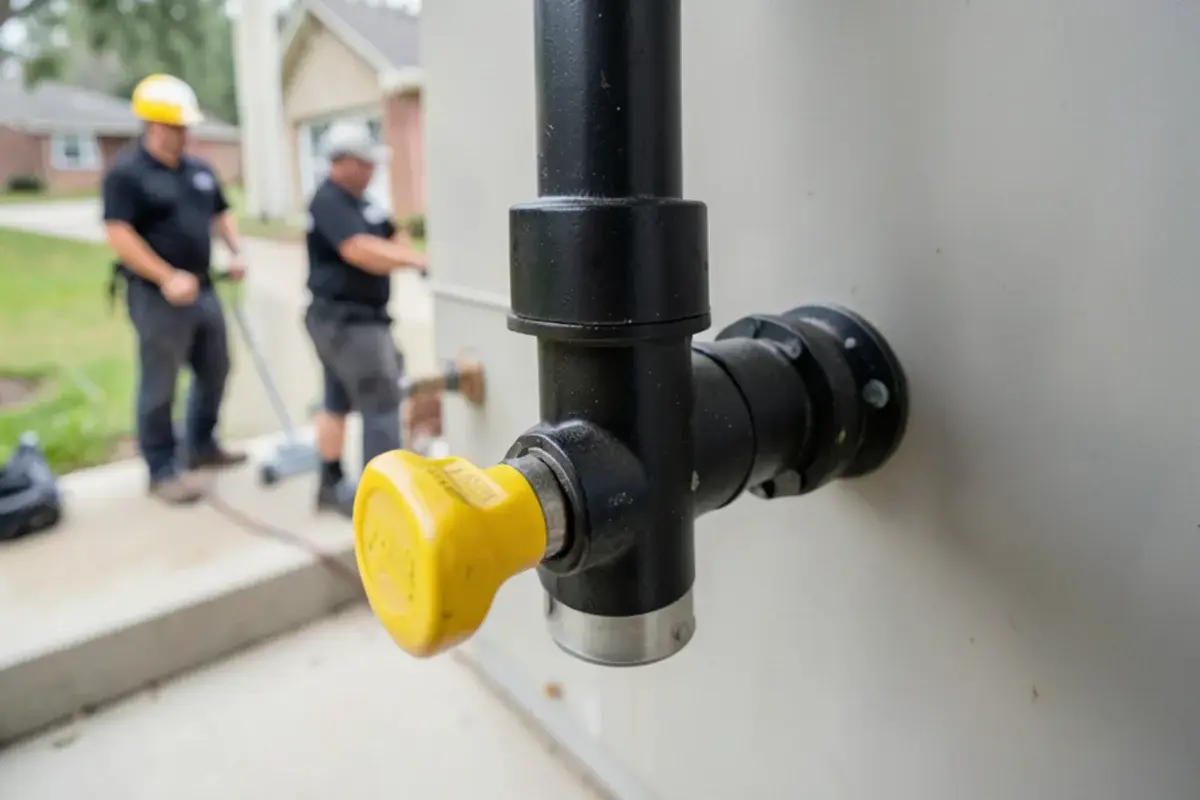
The job covers more than hanging the unit. A load review comes first, then the mount, the gas, water, vent and condensate runs, then testing at real flow. Service valves go in at the same time, because adding them later means cutting pipe again. If the gas line or panel cannot carry the unit, you hear that before anything is bought.
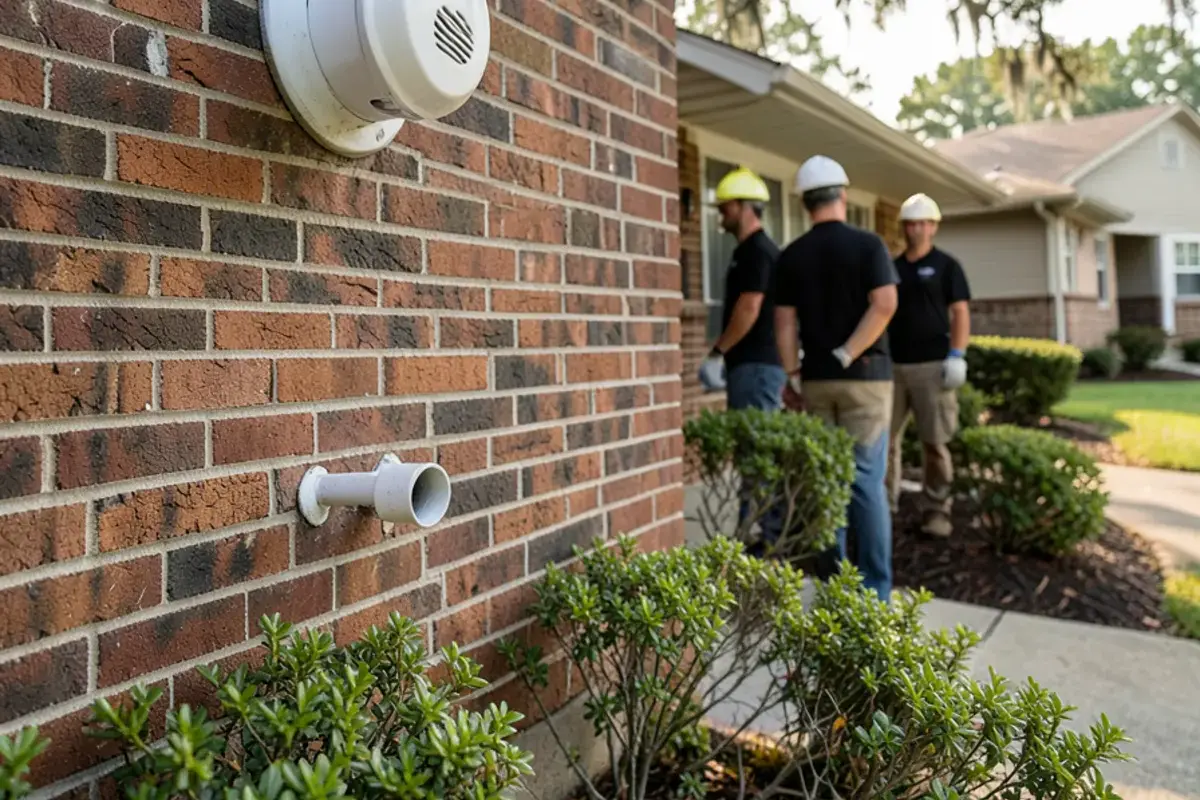
Venting is where models differ most. A Department of Energy building guide says noncondensing units exhaust near 300°F and need vent that resists heat and corrosion, such as Category 3 stainless steel. Condensing units run near 100°F, can use PVC and usually go out a sidewall. They also make mildly acidic water that has to be piped away, and the guide recommends a neutralizer, which needs its own upkeep.
The gas check looks at the whole system, not just the last few feet. The same guide says trunk and branch lines may need upsizing so pressure holds with every appliance running.
This work includes:
- A load and sizing review
- Mounting and connection of the unit
- Vent and condensate routing
- Flow and temperature tests
- A walkthrough of flushing needs
Tankless water heaters in Houston need a scale plan
Plan for scale from day one, because hard water is the top maintenance issue here. Department of Energy guidance says scale hits tankless heat exchangers harder than tanks, restricting flow and shortening the unit's life. It also notes that makers may require a softener once hardness passes 8 to 14 grains per gallon.
A published summary of the City's 2025 water report puts the Main System average near 7.9 grains, with some addresses higher. Read your own report, then choose:
- A tankless flush on the maker's schedule, from twice a year to once every three years
- Isolation service valves fitted at install, so flushing is simple
- A water softener upstream if your hardness calls for one
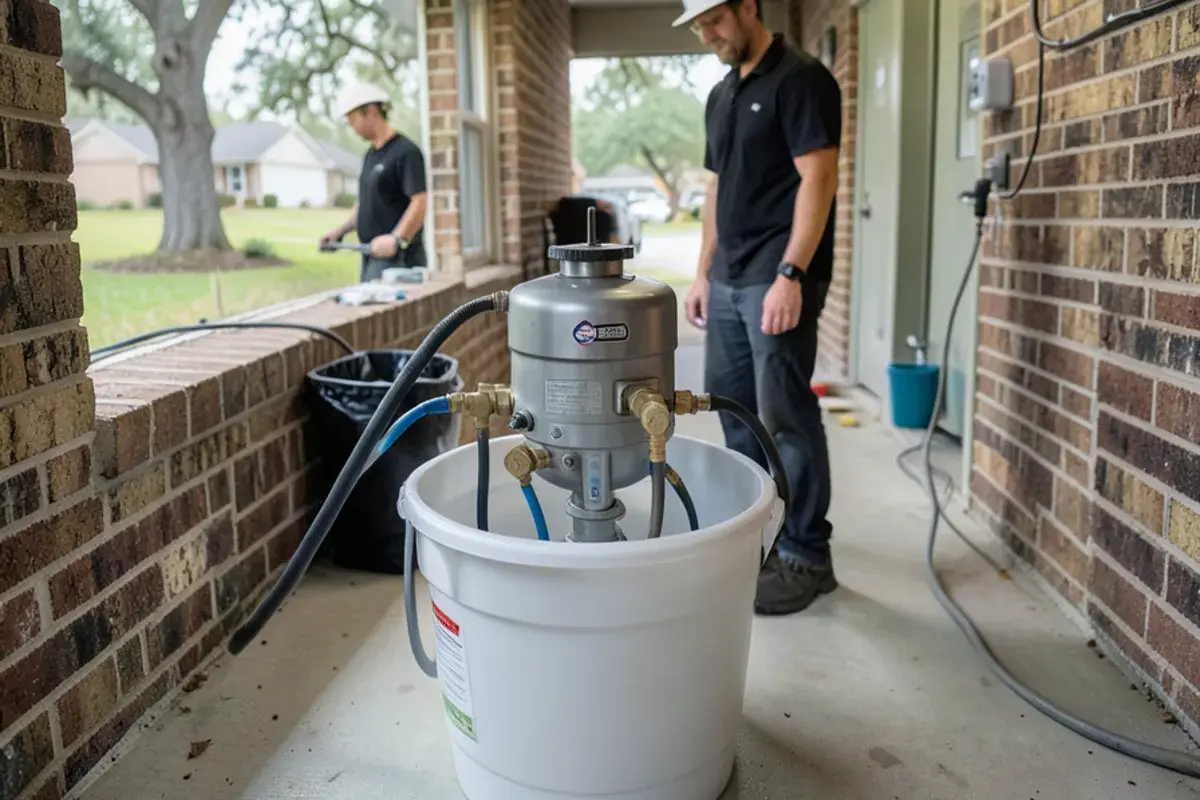
How an on demand water heater gets installed
The job runs in order, with the riskiest questions answered first:
- Tell us your fuel, bathroom count and how the household uses hot water.
- We check gas capacity, vent routes, cold supply, power and the drain.
- We size the unit against your peak flow and winter temperature rise.
- You get a clear, upfront quote that shows the upgrades.
- We remove the old heater and mount the new unit.
- We run gas, water, vent and condensate, then test flow, temperature and combustion.
What moves the price of a tankless project?
Upgrades move the price more than the unit does. The Department of Energy's 2012 guide found tankless units cost roughly one and a half to two times as much as tanks upfront, and that was before retrofit work. We look at the house and quote after that.
- Gas line or meter: the largest swing in many homes
- Vent route: a short wall run, or a long attic path
- Unit type: condensing or conventional, and output
- Location: garage, closet, attic or exterior wall
- Water treatment: softener or scale control
- Removal: taking out the old tank and capping lines
A first conversion costs more than replacing an existing tankless, because the gas, vent and condensate paths are all new. Gas pipe is the usual swing. The Department of Energy building guide notes that models on a 1/2-inch feed top out near 150,000 Btu an hour, so a larger unit can mean new pipe from the meter or trunk. Vent choice pulls the other way: stainless on a noncondensing unit, or PVC plus a drain and neutralizer on a condensing one. Ask to see both paths priced on one quote.
The federal Section 25C credit ended after December 31, 2025. For utility offers, confirm current Texas terms with CenterPoint.
Permits and rules for a tankless swap
The City's water heater rule applies here too. The Houston Permitting Center calls for a plumbing permit with inspection, pulled by a registered master plumber, so ask who pulls it. Also ask whether gas line changes add to that permit.
Nearby cities differ. West University Place asks for a gas riser diagram on tankless swaps, typically 5 to 7 business days, and Texas City's Building Department has a memo on tankless condensate. Plumbing in Texas falls under the Texas State Board of Plumbing Examiners. Ask the installer for a number and look it up. Where condensate may go is set by the manufacturer and local code, the Department of Energy guide says, so ask before you choose a condensing model.
Error codes and other tankless repair calls
Most tankless repair calls trace back to scale, gas supply, venting or low flow. Weak flow often means a clogged inlet screen or scale in the exchanger. Ignition faults can point to gas pressure or a blocked vent. Bring the error code when you call, because it narrows the tests. If the unit trips after running for a while, scale is the first suspect. Our water heater repair page covers tank units.
Why PipeElectric for tankless work?
Tankless jobs go wrong in the planning, so the conversation before the install counts most:
- Customers rate PipeElectric 5.0 on Google across 18 reviews.
- Reviews mention plain explanations, which helps with sizing choices.
- Customers also mention clean work and fair pricing.
- Every upgrade shows on a clear, upfront quote.
Friday hours run 7 AM to 6 PM. Sunday through Thursday close later, at 8 PM, and Saturday is closed. Have your fuel type and the gas meter's location ready, plus the model number if you already own a tankless.
We talk through tankless projects across the north side and beyond, including Cypress, Spring, Humble and Kingwood.
What customers say about our plumbing work
5.0 on Google from 18 reviews, checked October 2026.
“Had PipeElectric install a new water heater, and they did a fantastic job! Fast, professional, and no mess left behind. Highly recommend them for any plumbing work!”
“They had someone out to my house within a couple of hours. The technician was professional, he explained everything clearly, located the gas leak, and repaired it on the spot. He even double check the rest of the line to make sure there wasn't any other leak. I really appreciated how honest and thorough they were.I highly recommend PipeElectric to anyone looking for fast, affortable and caring service!”
“PipeElectric did a great job! Had a issue with some outlets and a small leak under my sink. They showed up on time, real professional and got everything fixed quick. Prices was fair too. Definitely calling them again if I need anything else!”
Tankless Water Heaters around Houston
- Cypress · Homes in 77433 date mostly from 2010 on, so first tank swaps raise the tankless question now.
- Spring · As MUDs move toward surface water under NHCRWA targets, ask yours about hardness before setting flush intervals.
- Humble · Atascocita, beside Humble, has a 2006 median home, so tankless comes up at first-tank replacement.
- Kingwood · Annexed in 1996, Kingwood falls under the Houston Permitting Center, so the City's heater permit rule applies.
- West University Place · A tankless swap here needs a gas riser diagram, typically 5 to 7 business days for review.
- Texas City · Building Department memos cover tankless condensate, so ask about the drain before picking a condensing unit.
- Sugar Land · City ranges reach 16.4 gpg on the Main system, past where makers may require softening.
- Pearland · With 34% of units built in the 2000s, second-tank decisions often include a tankless gas check.
Tankless Water Heaters questions
Will my current gas line handle a tankless water heater?
It may not. A gas tankless can add 175,000 Btu or more to the home's load, according to a Department of Energy guide, far more than a typical tank. The line usually needs to be 3/4 inch, and the meter may need upsizing. A plumber checks the run length and total load before you commit.
Do tankless water heaters work when the power goes out?
No, not without backup. Gas tankless units have electric controls and fans, so an outage means no hot water, the Department of Energy notes, unless a battery backup is fitted. That matters during Houston storm outages. Keep it in mind if you rely on a tank that still runs without power.
How often does a tankless need flushing in Houston?
Follow the maker's schedule, then adjust for your water. The Department of Energy reports intervals from twice a year to once every three years. Hardness in the City's Main System sits near where some makers begin to ask for softening, so lean toward the shorter end unless your water is softened.
Can a tankless run two showers at once?
It can if it is sized for that. A shower runs about 2.5 gallons a minute, so two showers need roughly 5 gallons a minute of hot flow, before you add a dishwasher. Check the maker's flow table at your winter temperature rise. Larger homes sometimes use two units.
Can a tankless water heater go outside or in the attic?
Both are possible with the right model. Outdoor units avoid indoor venting but need freeze protection, which depends on power, and February 2021 showed how that can fail. Attic units need a pan, safe access and a vent path. Centrally located units also shorten the wait for hot water.
Why does my tankless shower go cold for a moment?
That is usually the cold water sandwich. Turn a tap off and back on, and a slug of unheated water passes through before the burner refires. The Department of Energy calls it uncommon and limited to frequent on-off use. If it is new, or lasts longer than a few seconds, have the unit checked.
Weighing tankless for your home? Call with your fuel type and bathroom count.
- ★ 5.0 on Google, 18 reviews
- Sun–Thu 7 AM–8 PM · Fri 7 AM–6 PM · Sat closed
- Clear, upfront quote
PipeElectric - Plumbing & Electrical - HVAC · Houston, TX · (321) 559-0657