
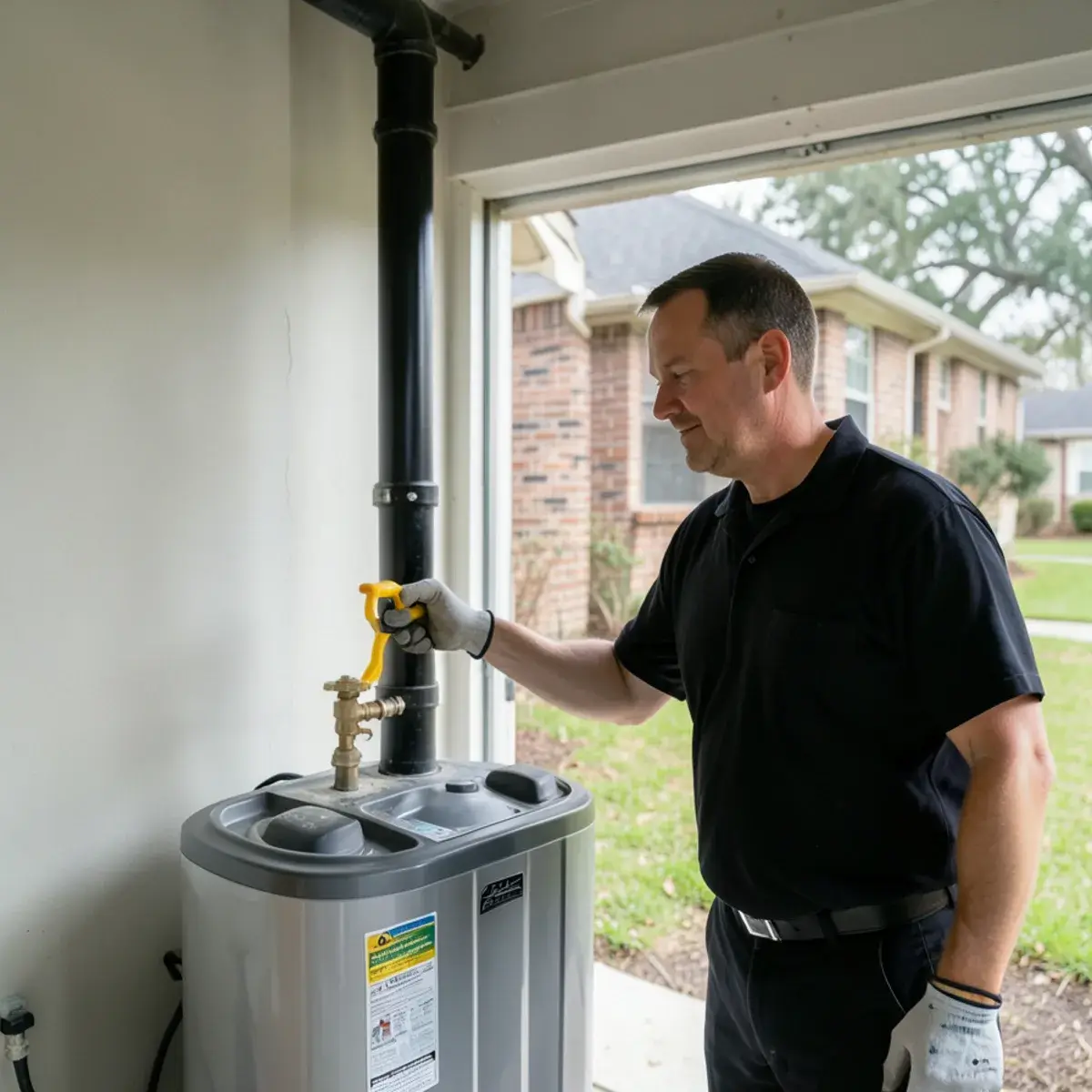
If you smell gas, leave the building now and call 911 and your gas utility from outside. Do not call a plumber first. Gas line repair and installation in Houston comes after that: finding the leak, fixing or replacing the pipe on your side of the meter, and proving the line holds pressure.
What should you do if you smell gas?
Leave first, then call from a safe place. CenterPoint Energy's guidance is plain, and it comes before everything else on this page:
- Leave the building on foot and get everyone out, pets too.
- Do not use light switches, phones, appliances, matches, or anything that can spark.
- Do not start a car near the smell.
- Walk away and upwind of the smell or any hissing.
- From a safe distance, call 911 and your gas utility.
CenterPoint lists 713-659-2111 or 800-752-8036 for its gas leak line in the Houston area. If another company supplies your gas, use the number on your bill. Do not assume a neighbor has already called, and do not report a leak by email or online. CenterPoint says it checks reported odors at no charge.
Stay out until emergency crews say it is safe. Call us after that, and only for the repair. This is true at any hour, including when our phones are closed.
What are the signs of a gas leak?
Natural gas is given a rotten egg odor so people can notice it, and that odor is the main warning. Treat these as a reason to leave:
- A sulfur or rotten egg smell indoors or near the meter
- Hissing near a line, valve or appliance
- Bubbles in standing water over a buried line
- Dead grass or plants in a strip above a buried line
- A flame on a stove that burns yellow rather than blue, along with an odor
Headaches or dizziness that ease when you go outside can point to carbon monoxide. Leave, and call 911.
Gas line red-tagged or failed a test? Call once the house is safe.
- ★ 5.0 on Google, 18 reviews
- Sun–Thu 7 AM–8 PM · Fri 7 AM–6 PM · Sat closed
- Clear, upfront quote
Why do gas lines fail in Houston homes?
Most failures are at joints and connectors, or in buried metal pipe. The causes here are local as well as general:
- Corrosion: steel in wet clay loses its coating and rusts from the outside in
- Ground movement: expansive clay stresses pipe and joints near the riser
- Loose or aged connectors: stoves and dryers get pulled out, and connectors kink
- Digging: fence posts and landscaping can strike a shallow line
- Added load: a new appliance on a line too small to feed it
That last one is a design failure and not a leak. A burner that starves when the water heater fires is often a sizing problem.
Who is responsible for which gas line?
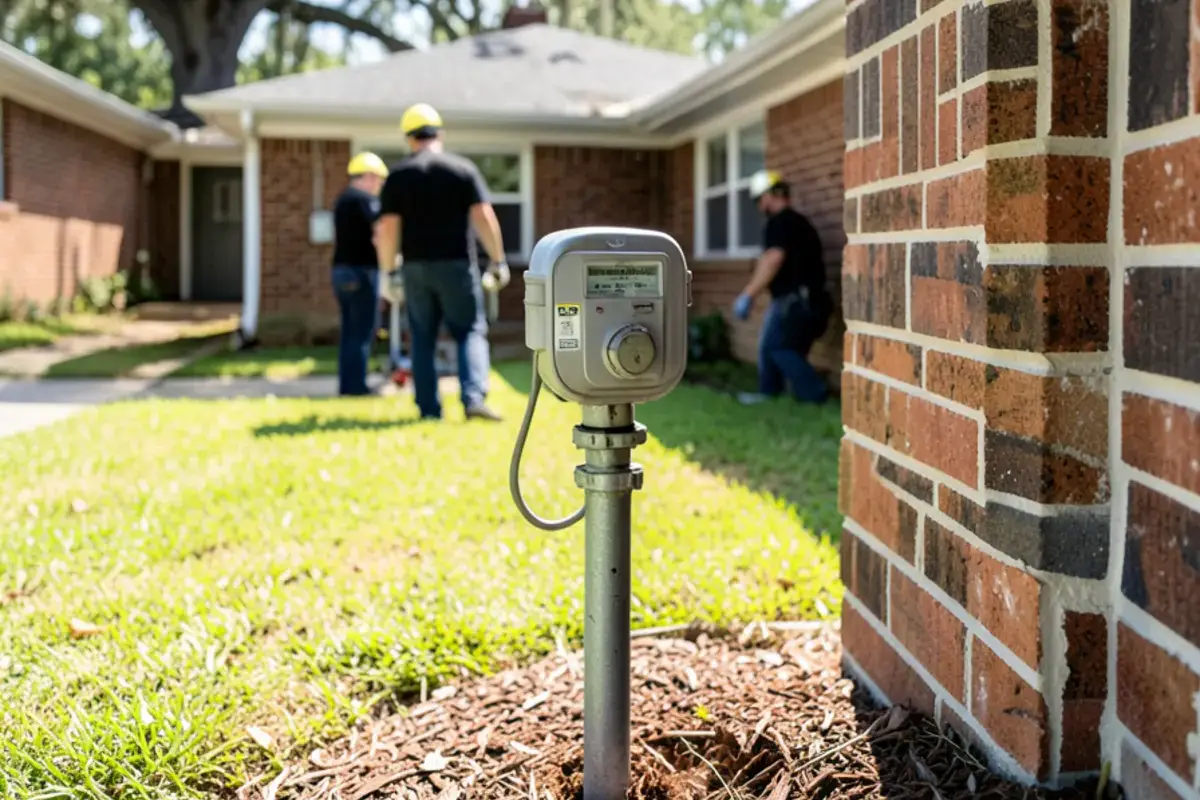
The utility owns its system up to the point of delivery, and you own what lies past it. CenterPoint's Texas rules say the customer is responsible for equipment downstream of that point. Its notice to customers covers buried piping running from the meter to a structure or to equipment such as yard lights, pool heaters and grills, and it tells owners to have that piping checked.
Digging has its own rule. The Railroad Commission of Texas says anyone digging deeper than 16 inches must call 811 first, then wait 48 hours, not counting weekends and legal holidays, so buried lines can be marked. That applies to homeowners too. Private lines past the meter are usually not marked by 811, so tell the plumber what you know about any run in the yard.
How do you keep gas lines safe?
A few habits prevent most trouble. Know where the shut-off is at each appliance and at the meter. Do not hang anything on gas pipe. Move stoves and dryers gently so connectors do not kink. Have buried lines checked as CenterPoint advises, and call 811 before any fence or garden project.
Install carbon monoxide alarms near bedrooms, and have an appliance checked before relighting it if floodwater reached it.
How is a gas line inspected and tested?
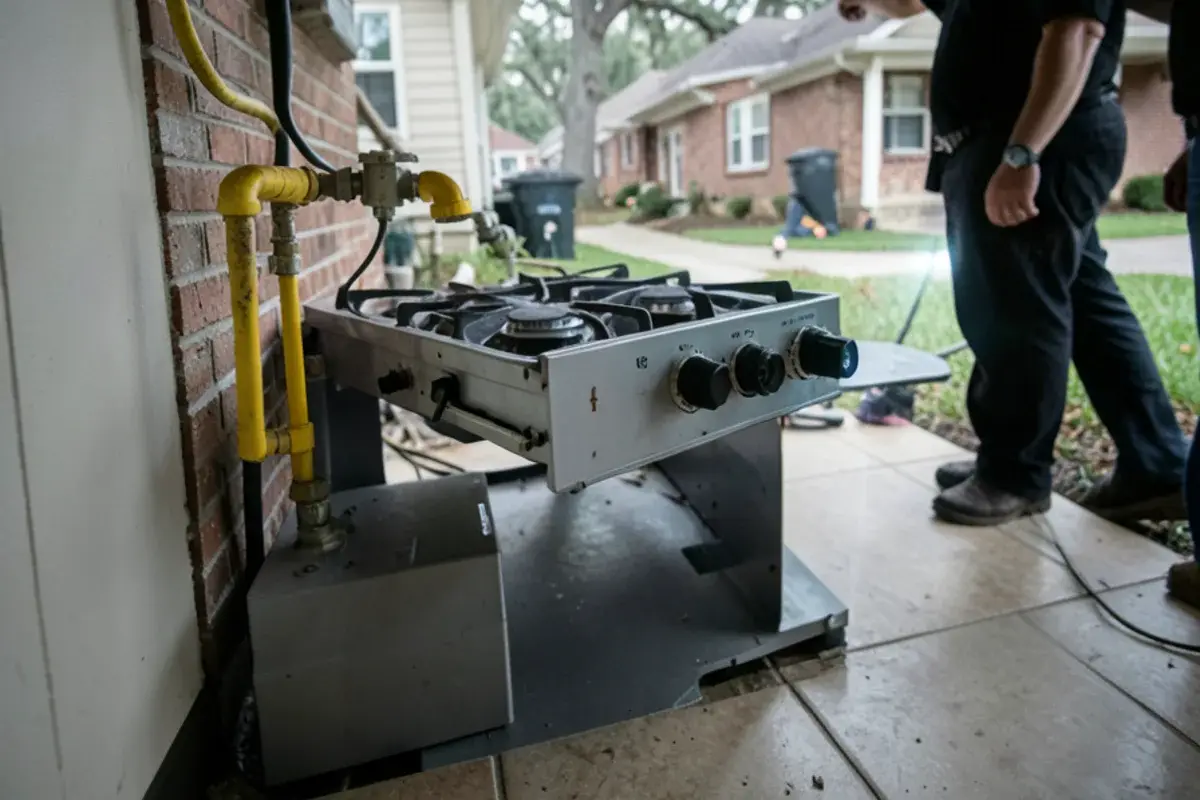
Testing proves the line, and no one should sign off on gas by smell. The usual order:
- Confirm the utility has cleared the site, if a leak was reported.
- Shut the gas and isolate the suspect section.
- Run a gas pipe pressure test to confirm a leak exists.
- Pinpoint it with an electronic detector and leak solution on the joints.
- Inspect the pipe, the connectors and any buried run.
- Check that pipe size suits the appliance load.
Which gas line repair or installation is right?
Match the job to the pipe's condition and to what it feeds.
| Situation | Option | Works well when | Trade-off |
|---|---|---|---|
| Leaking joint or valve | Remake or replace it | Pipe around it is sound | Other old joints remain |
| Failed appliance connector | New connector and valve check | Leak is at the appliance | Fixes that point only |
| Corroded buried steel | Replace with new underground pipe | Trench route is clear | Digging, 811 first |
| New range, dryer or grill | Gas line installation from the nearest adequate pipe | Line has spare capacity | Wall or attic routing |
| Tankless heater | Dedicated, larger line | Meter can supply the load | A longer run, possible utility review |
Pipe materials are chosen for the location. Black steel suits exposed indoor runs, and corrugated stainless tubing bends through tight framing but must follow its bonding instructions. Polyethylene goes underground and must not run exposed. Whichever is used, a stove gas line or a tankless water heater run should end at an accessible shut-off valve.
Gas line repair and installation in Houston, step by step
Once the site is safe, a visit follows one order:
- Call and tell us the appliance, the symptom and whether the utility has been out.
- We inspect the line and test for a leak.
- We explain the cause and the options in plain terms.
- A clear, upfront quote comes before any pipe work.
- We make the repair or install the new run.
- We pressure test the line and go over results and any step left for the city or utility.
What this work includes:
- Leak test and pipe inspection
- Gas leak repair or new pipe, with shut-off valves
- A pressure test of the finished line
- A plain explanation of what failed
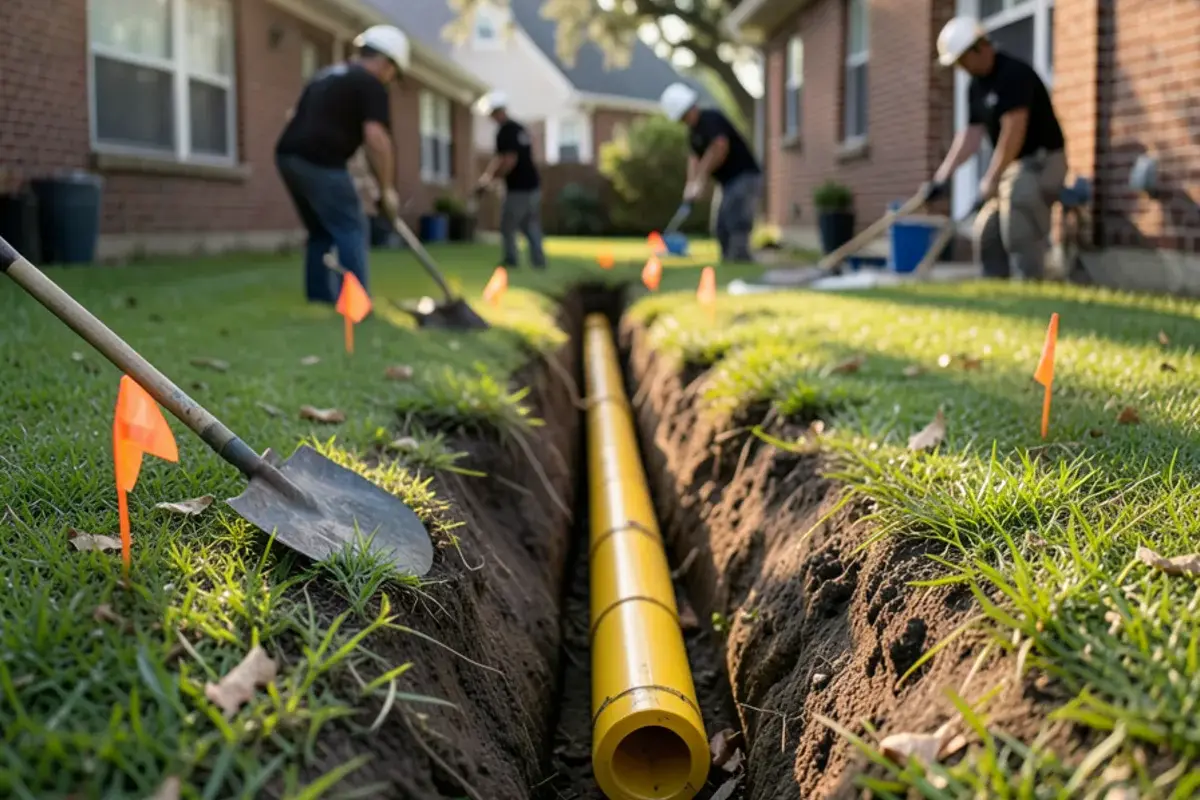
Repair work starts at the leak and ends at a tested line. A leaking joint is taken apart and remade, a kinked connector is replaced rather than straightened, and a corroded length is cut back to sound pipe. A new run starts where the pipe can carry the added load, ends at an accessible shut-off valve, and gets a connector rated for the appliance. Buried runs need a clear trench route, 811 marks where they apply, and pipe made for underground use. Each new joint is checked again once the appliance is back on, along with the shut-off at that appliance. A faulty burner or control on the appliance is a separate repair, and the meter, regulator and service line belong to the utility. If the utility shut off service, it decides when the meter comes back.
Ask early who handles permits, and how the utility restores service if it was shut off.
What affects the cost of gas line work?
Length, location and testing shape the cost, so a quote waits until the route has been walked.
- Run length: a few feet to a stove, or a long trip from the meter
- Route: attic, walls, crawlspace or trench
- Pipe size: whether the existing line can carry the new load
- Materials: steel, stainless tubing or underground pipe
- City steps: whether your job needs a permit and inspection
Gas jobs are priced by the path and the load. A stove stub is a short job if the attic above that wall is open. A tankless heater often needs a larger dedicated line back toward the meter, and on a slab home that usually means a long attic run, since the pipe cannot go under the floor. Replacing buried steel adds trenching, hand digging near marked utilities, and lawn or walkway repair. Meter capacity can change the plan, because a big new load may need utility review. A leak found during testing adds repair time.
Who sets the rules for gas piping?
The City adopted the 2021 Uniform Plumbing Code with amendments, and that code includes fuel gas piping. Ask the Houston Permitting Center at 832-394-9000 what your job needs. A Houston Fire Department appendix says gas test permits go to a licensed plumber or approved gas equipment service company. Elsewhere, Lake Jackson has its inspector report a passed gas test so that CenterPoint can be notified.
Under Texas Occupations Code Chapter 1301, piping that distributes gas counts as plumbing. That puts it with the state's regulator, the Texas State Board of Plumbing Examiners. Get the license number from anyone working on your gas line.
Why PipeElectric for gas line service?
Gas work should be calm, thorough and explained. These are the things customers mention:
- Rated 5.0 from 18 Google reviews
- Being told clearly what failed and why
- Clean work and on-time arrival
- Pricing customers call fair, starting from a clear, upfront quote
A red-tagged line leaves you dealing with the utility, the city and a plumber at once, so plain explanations help most here. Smell-gas calls go to 911 and the utility first, and our part starts once the site is cleared. Our phones start at 7 AM, Sunday through Friday. They stop at 8 PM, except for a 6 PM Friday close.
We take gas line calls across Houston and nearby, including South Houston, Pasadena, Tomball and Richmond.
What customers say about our plumbing work
5.0 on Google from 18 reviews, checked October 2026.
“They had someone out to my house within a couple of hours. The technician was professional, he explained everything clearly, located the gas leak, and repaired it on the spot. He even double check the rest of the line to make sure there wasn't any other leak. I really appreciated how honest and thorough they were.I highly recommend PipeElectric to anyone looking for fast, affortable and caring service!”
“Had PipeElectric install a new water heater, and they did a fantastic job! Fast, professional, and no mess left behind. Highly recommend them for any plumbing work!”
“PipeElectric did a great job! Had a issue with some outlets and a small leak under my sink. They showed up on time, real professional and got everything fixed quick. Prices was fair too. Definitely calling them again if I need anything else!”
Gas Line Repair and Installation around Houston
- South Houston · Inspection Department closes at 11:15 AM Friday, so plan gas permits early.
- Pasadena · City permits stop at 4:30 p.m., so plan gas paperwork early.
- Tomball · A 1935 Humble Oil deal gave residents free gas, so test older lines.
- Richmond · 35% of homes date from 1960-79, so check buried steel yard lines.
- League City · Gas reconnection needs a League City permit, so plan before service returns.
- West University Place · Tankless swaps here need a gas riser diagram, usually adding 5 to 7 business days.
- Deer Park · Deer Park lists a gas test among its plumbing inspection stages.
- Lake Jackson · City inspectors report passed gas tests here; at 56 miles, call first.
Gas Line Repair and Installation questions
Who fixes a gas leak: the utility or a plumber?
It depends which side of the meter the leak is on. CenterPoint Energy handles its own system, and the utility will shut off gas if it finds a hazard. The Texas rule for CenterPoint customers puts equipment past the point of delivery on the customer, so a leak on house piping needs a qualified plumber.
What does a gas pipe pressure test involve?
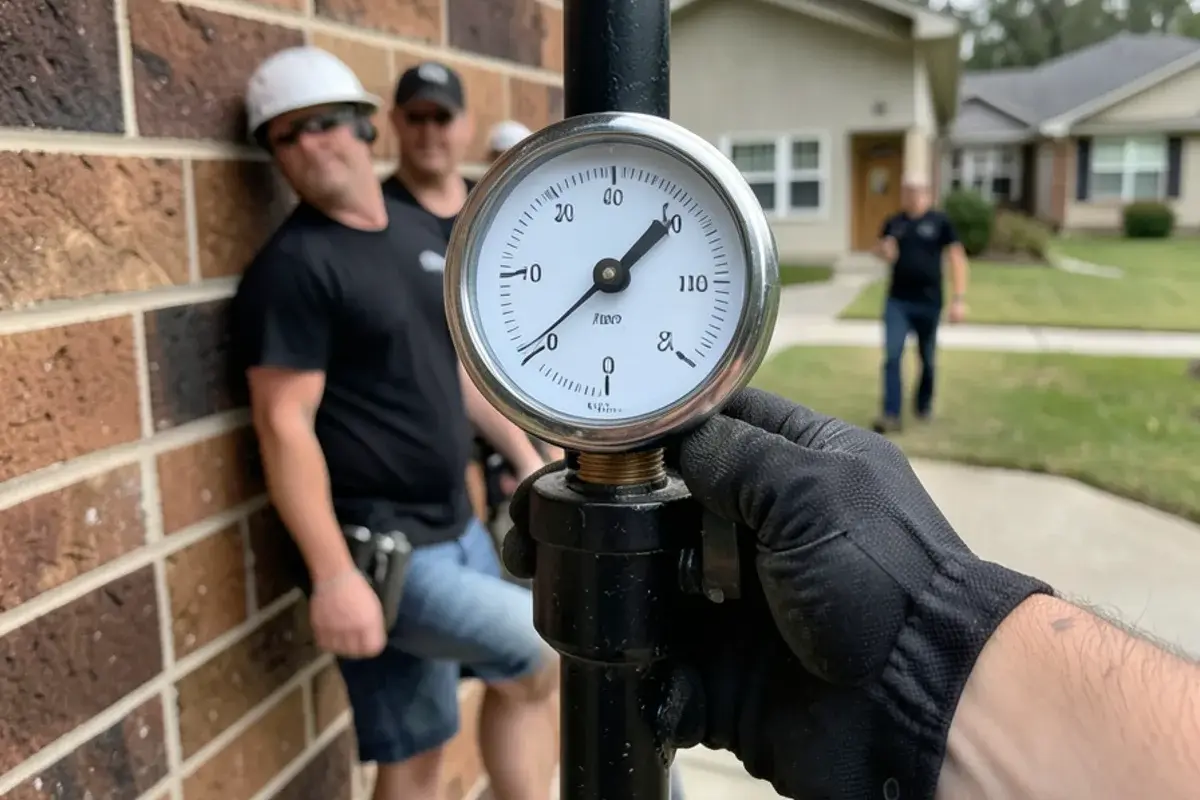
The line is closed off from the supply and appliances, then pressurized with a gauge attached. The gauge has to hold steady for the required time. Any drop means a leak somewhere. The pressure and duration come from the code your city enforces, so a tested line ends with a recorded result and not a guess.
Does a tankless water heater need a new gas line?
Often, yes. Tankless units draw far more gas when firing than a tank, and a dedicated 3/4-inch line is the common requirement. Existing half-inch branches frequently cannot carry that load. Check the size of the meter and the run length before buying, because both decide whether the line can feed the heater.
Can I connect my own stove or dryer gas line?
Yes on your own homestead, under Texas law, but gas is the poorest place to learn. A replacement connector on an existing valve is one thing, and new piping is another. Use a new connector, never reuse an old one, and have any new run pressure tested.
What about a buried gas line to my grill or pool heater?
That line is yours to maintain. CenterPoint's Texas notice tells owners to have buried piping checked for leaks and metal piping for corrosion, and to fix anything unsafe. If your meter sits against the wall and the pipe enters above ground, that notice does not apply. Call 811 before digging near it.
Is propane handled the same way as natural gas?
Not quite. Natural gas piping in a house falls under plumbing law, while LP gas systems are also regulated by the Railroad Commission of Texas, and licensed LP gas installers can perform that work under their own license. Tell us your fuel when you call, so the right trade handles it.
Utility cleared the house and red-tagged the line? Call about the repair.
- ★ 5.0 on Google, 18 reviews
- Sun–Thu 7 AM–8 PM · Fri 7 AM–6 PM · Sat closed
- Clear, upfront quote
PipeElectric - Plumbing & Electrical - HVAC · Houston, TX · (321) 559-0657