
By the PipeElectric team · Published October 30, 2026 · Updated October 30, 2026
In the tankless vs tank water heater choice, a tank wins on purchase price and easy replacement, while tankless wins on endless hot water, floor space and long service life. Most Texas homes should decide on three facts: how many fixtures run at once, how long you will stay, and what your gas line can support.
How do tankless and tank heaters compare side by side?
A tank costs less on day one, and a tankless unit can cost less to run. Here are the main differences:
| Factor | Standard tank | Tankless |
|---|---|---|
| Unit price, before installation (Bob Vila) | $450 to $750 | $800 to $1,150 |
| How it heats | Stores and reheats water | Heats water on demand |
| Limit | Tank capacity and first-hour rating | Gallons per minute at one time |
| Standby heat loss | Yes | None from storage |
| Rated energy factor, gas (PNNL) | 0.57 to 0.70 | 0.82 to 0.94 |
| Expected life | 10 to 15 years (PNNL) | About 20 years (ENERGY STAR) |
| Space | Floor closet or garage | Wall-hung |
| Replacing like for like | Usually simple | First install often needs gas and vent changes |
Those prices are national market figures for the unit alone, so they are not PipeElectric prices. Your quote depends on your gas line, venting and location.
Old heater on its way out? Call before it decides for you.
- ★ 5.0 on Google, 18 reviews
- Sun–Thu 7 AM–8 PM · Fri 7 AM–6 PM · Sat closed
- Clear, upfront quote
Does tankless really save money in Texas?
Yes on the monthly bill, but the payback depends on your installation cost. ENERGY STAR says a certified gas tankless unit saves a family of four about $95 a year compared with a standard gas tank, or about $1,800 over the unit's life. The Department of Energy's figure, as reported by Bob Vila, is 24 to 34 percent better efficiency depending on daily hot water demand.
Run the numbers before you decide:
- The unit price gap above is roughly $350 to $400.
- At $95 a year, that gap alone takes about four years to recover.
- New gas line, venting or electrical work adds to the gap.
- If the first install needs that extra work, the payback runs much longer.
Installed cost is where the math gets harder. Pacific Northwest National Laboratory's building guide says a gas tankless job often runs 1.5 to 2 times the installed cost of a tank. Take a $1,500 tank job purely as an example. Tankless would then land near $2,250 to $3,000, a gap of $750 to $1,500, and at $95 a year that gap takes roughly 8 to 16 years to recover. That still fits inside a 20-year life, but only if you stay. The same guide adds that removing an old flue can sometimes lower the cost, so a real quote can beat this example.
Texas has one edge. Bob Vila's guide notes that cold groundwater in northern regions can limit a tankless unit, and warmer incoming water helps here. The savings figures are national, though, and your household's use matters more than the state you live in.
How many fixtures can a tankless heater run at once?
As many as its flow rating covers at your incoming water temperature. Tankless units are sized in gallons per minute, and ENERGY STAR lists these average demands:
- Shower or bathtub: 2.5 GPM
- Clothes washer: 3.3 GPM
- Kitchen or bathroom sink: 2.2 GPM
- Dishwasher: 1.3 GPM
A shower, a washer and a sink running together add up to 8.0 GPM. That is a large demand for one unit. Most families do not run all of them together, so a plumber should estimate your real peak. Undersizing shows up as water that goes lukewarm when someone starts the dishwasher.
Size for the coldest water of the year. A unit's flow rating drops as the temperature rise grows, so a heater that keeps up in August can fall short in January, even in Houston. Small draws matter as well. PNNL notes that hand washing can call for less than 0.5 GPM and that not every model fires that low, so check the listed minimum flow.
How do you size a tank instead?
Tanks are sized by the first-hour rating on the label. ENERGY STAR describes that number as how much hot water the heater can deliver in a busy hour, and a higher rating can improve performance without a larger tank. Add up your busiest hour at home, then match it. That one figure is the fair comparison with a tankless flow rating.
What happens to each heater when the power goes out?
A tank handles outages better, and Houston has seen long ones. About 2.2 million CenterPoint customers lost power to Hurricane Beryl in 2024, many for days.
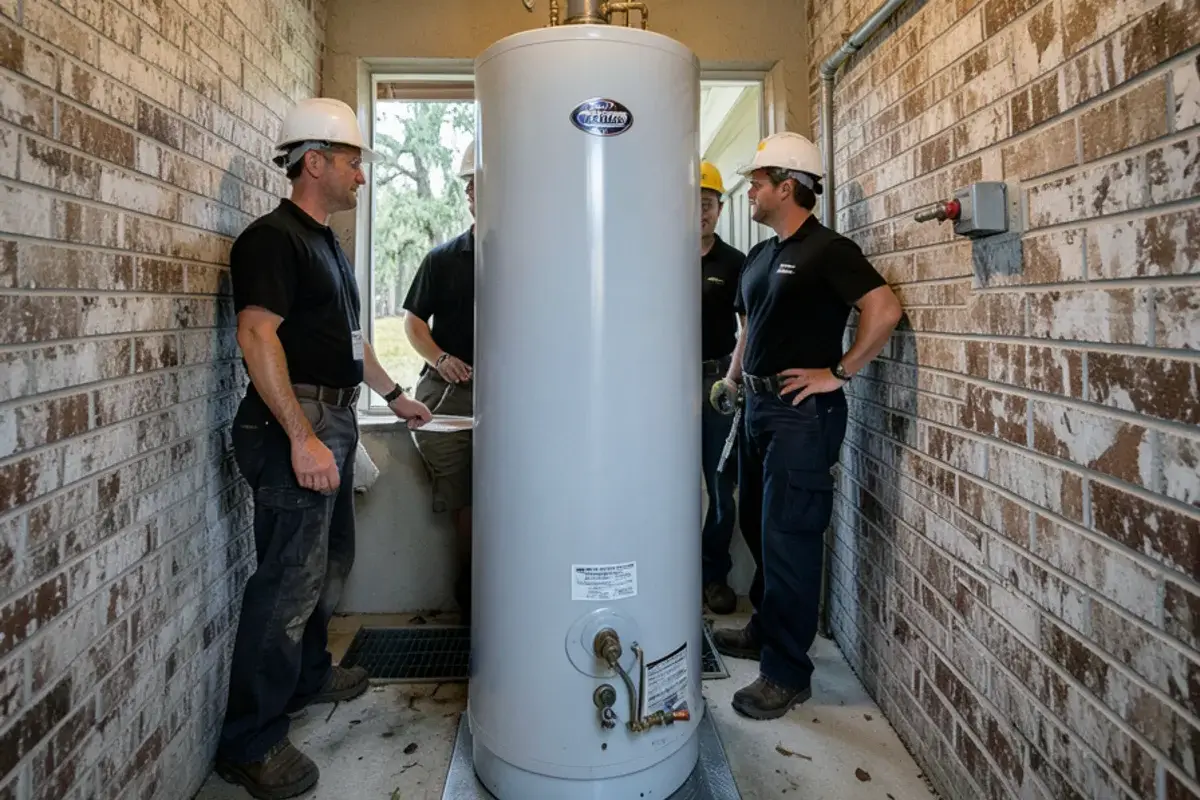
Most tank heaters hold hot water for a while after power loss, and a gas tank with a standing pilot may keep heating. An electric tank stops heating, as do most tankless units, gas or electric. ENERGY STAR notes that forced-ventilation tankless models need electricity near the unit.
If you depend on hot water through outages, weigh this as heavily as the energy savings.
What has to change to install a tankless heater?
The first tankless install is more of a project than a swap. ENERGY STAR says an installer should confirm four things:
- The right GPM size for your home.
- Whether your existing gas line is adequate.
- Whether electricity is close to the unit.
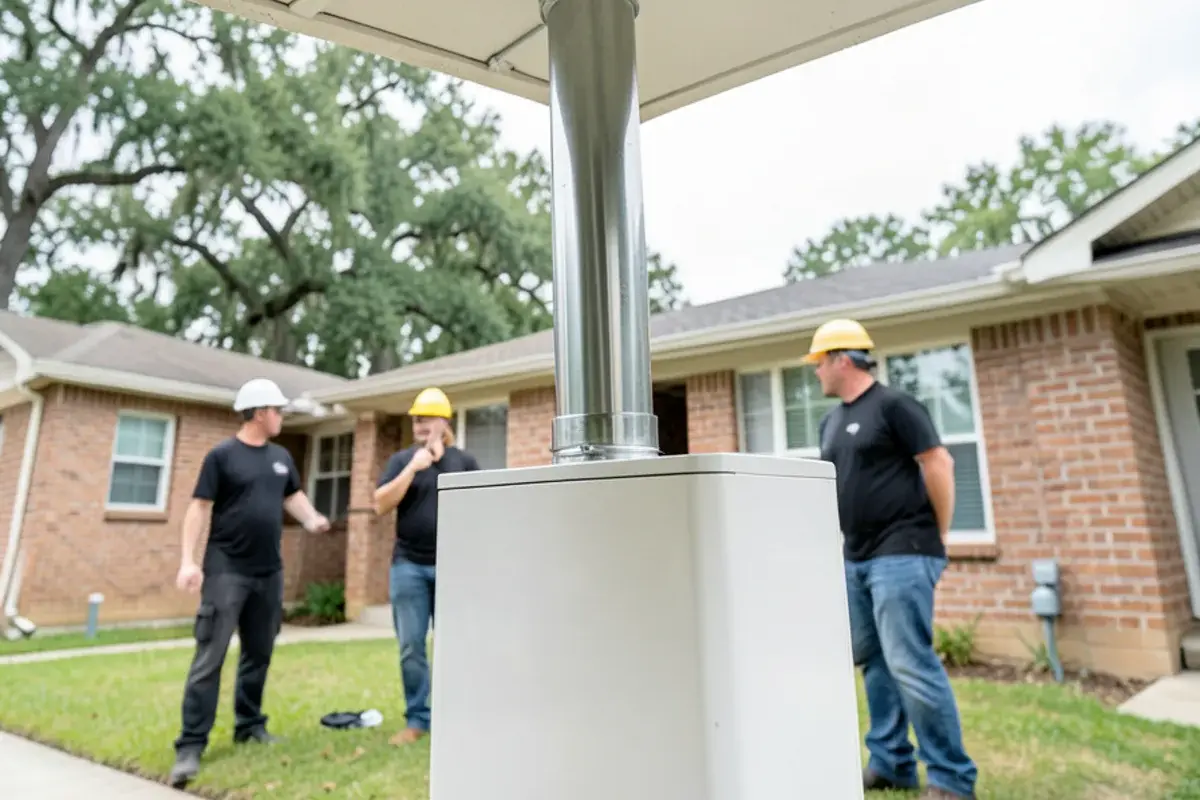
- How combustion gases will be vented.
Gas supply is often the deciding item. A large tankless unit can demand more gas than the existing line was sized for. PNNL gives one example of 199,900 BTUs for a tankless unit against 40,000 for a typical tank, and it says a tankless unit may need a 3/4-inch branch line where many tanks get by on 1/2-inch. An electric tankless unit brings its own question, since it can require far more electrical capacity than a tank.
Condensing or non-condensing?
The vent follows from this choice. Non-condensing units run near 80 percent efficiency and need corrosion-resistant vent pipe such as stainless steel. Condensing units top 90 percent, can often vent through PVC, and produce acidic condensate that needs a drain and a neutralizer, according to PNNL.
Three more items belong in the plan:
- Shared flue: A tank that shared a flue with a furnace can leave that flue oversized, so the installer should test the draft.
- Service valves: PNNL recommends fitting flush-kit valves at installation, which makes yearly descaling much easier.
- Location: Many Houston tanks sit in attics or garages, and moving the heater to an outside wall can shorten the vent while lengthening the hot water run.
ENERGY STAR also suggests planning ahead, because ordering and installing the right model can take longer than a standard replacement. Our tankless water heater page covers those steps.
What rule of thumb does our team use?
Our team's rule of thumb is to plan a tankless change before the tank fails. A leaking heater pushes you toward the quickest fix, which is usually another tank. Six months of notice gives you time to check the gas line, get written estimates and pick a location.
Three situations tend to favor a standard tank, whatever the efficiency numbers say:
- You expect to sell the house within a few years
- You have a low-demand household with a healthy existing setup
- You want the simplest backup during long outages
Hard water is the other watch-out. Tankless units have narrow passages, so scale deserves a place in the upkeep plan. Ask what yearly service the maker calls for.
Tankless vs tank water heater: which should you pick?
Pick the one that fits your house and your timeline. Use this short test:
Choose a tank if:
- Upfront cost is the main constraint
- Your gas line and vent are not easily changed
- You want hot water available during outages
Choose tankless if:
- You plan to stay long enough to reach the payback
- Your family keeps running out of hot water from a tank
- You need the floor space
Before you sign, check rebates, since the federal credit ended for work after 2025. Ask about current Texas utility terms. Homeowners in Spring Valley Village, Sugar Land and across Houston can call us about water heater installation, and the quote comes after a look at the job.
Common questions
Does a tankless water heater work during a power outage?
Generally no, even on gas, because the controls need electricity and many models use a fan to vent. A gas tank with a standing pilot can often keep heating, and any tank still holds hot water for a while. If outages are your main worry, ask how a specific model behaves before you buy, and whether it can run from a generator safely.
Is there still a federal tax credit for a new water heater?
Not for work done now. The IRS says the Energy Efficient Home Improvement Credit covered improvements made through December 31, 2025. Rebates may still exist through utilities or state programs, so check the ENERGY STAR rebate finder and ask your gas or electric utility for current Texas terms before you count on any amount.
Can a tankless water heater go in a Houston attic?
Yes, but it needs more planning than a garage wall. The attic must have room for service, and the vent, gas line and any condensate drain all have to reach it. A condensing unit's drain should stay clear of freezing air. Many owners choose a garage or outside wall, because yearly descaling is easier without a ladder and a hot attic.
Why do I get a burst of cold water with a tankless heater?
That is the cold sandwich, and it is normal on many units. Hot water left in the pipe from your last use comes out first, then cold water passes through while the burner fires, then hot arrives. Turning the shower off and on quickly makes it easy to notice. A small buffer tank or recirculation setup can reduce it.
Weighing tankless against a new tank? Call and talk through your home.
- ★ 5.0 on Google, 18 reviews
- Sun–Thu 7 AM–8 PM · Fri 7 AM–6 PM · Sat closed
- Clear, upfront quote
Written by the PipeElectric team
PipeElectric is a Houston plumbing company with 18 Google reviews and a 5.0 rating. Read about us.
Sources
- ENERGY STAR: Whole Home Tankless Gas Water Heaters
- ENERGY STAR: Tankless water heater benefits and savings
- Bob Vila: Tankless hot water heater guide, citing U.S. Department of Energy
- IRS: Energy Efficient Home Improvement Credit
- Wikipedia: Hurricane Beryl
- Pacific Northwest National Laboratory, Building America: Gas-Fired Tankless Water Heaters
- ENERGY STAR: High Efficiency Gas Storage Water Heaters