
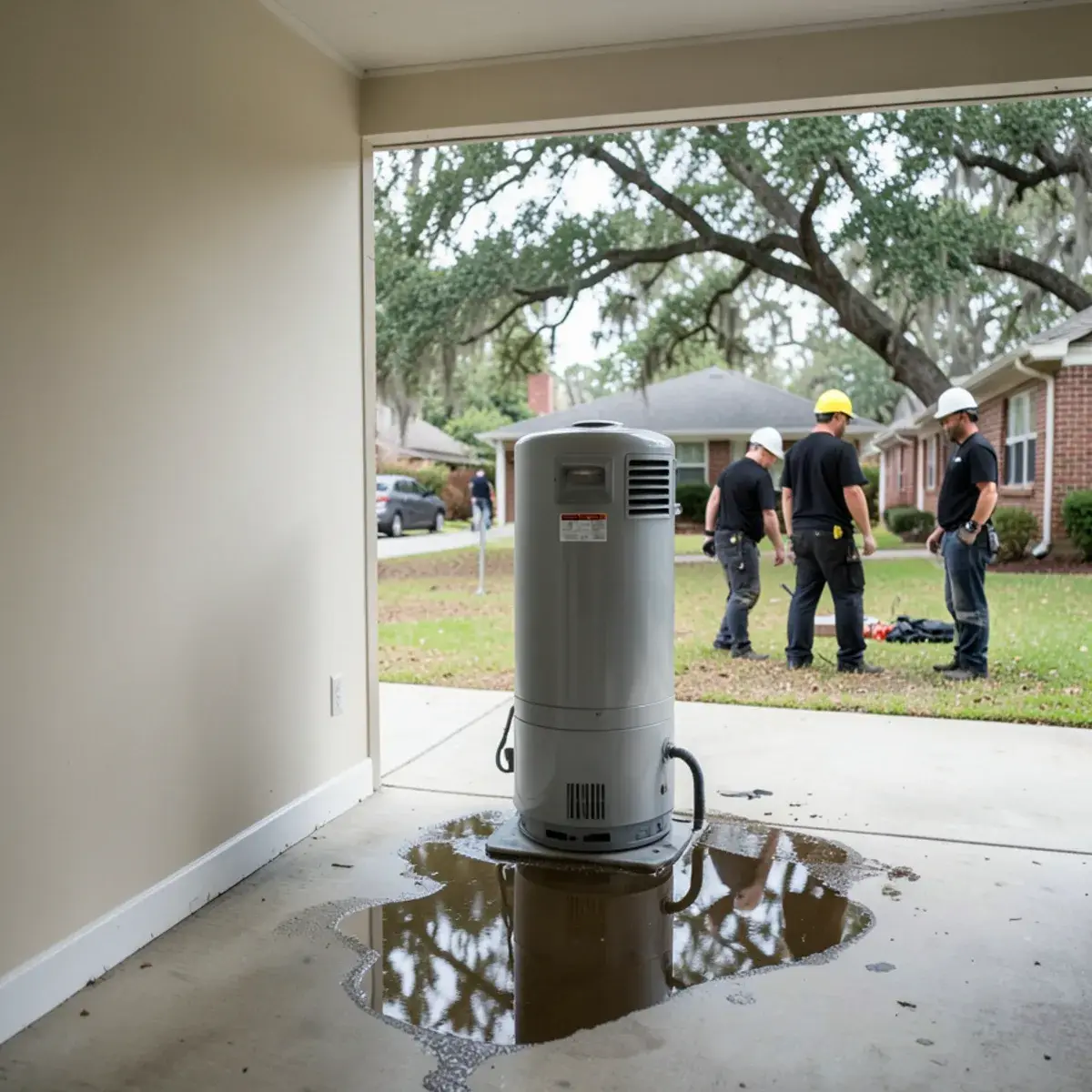
By the PipeElectric team · Published October 30, 2026 · Updated October 30, 2026
Water heater leaking? What to do first depends on what you smell. If it is gas, leave the house. If not, close the cold water inlet on top of the tank, turn off the gas control or the breaker, and find the source. A drip at a fitting can wait a little. Water from the bottom cannot.
Water heater leaking: what to do in the next five minutes
Follow this order, and treat gas as the first test. The steps assume no gas smell. If you notice one, leave the house, then call 911 and CenterPoint Energy from outside. Do not touch switches on the way out, since electrical equipment can ignite gas.
- Close the cold inlet. Turn the valve on the cold pipe above the tank. If it will not move, close the main shut-off valve for the house.
- Cut the energy. Turn a gas control to off, or switch off the double breaker for an electric unit.
- Keep clear of hot water. The CPSC says most adults suffer third-degree burns from 150 degree water in two seconds, and from 140 degree water in six.
- Protect the room. Move boxes off the floor, and keep water away from outlets.
- Take photos. Capture the leak point, the data label and any damage.
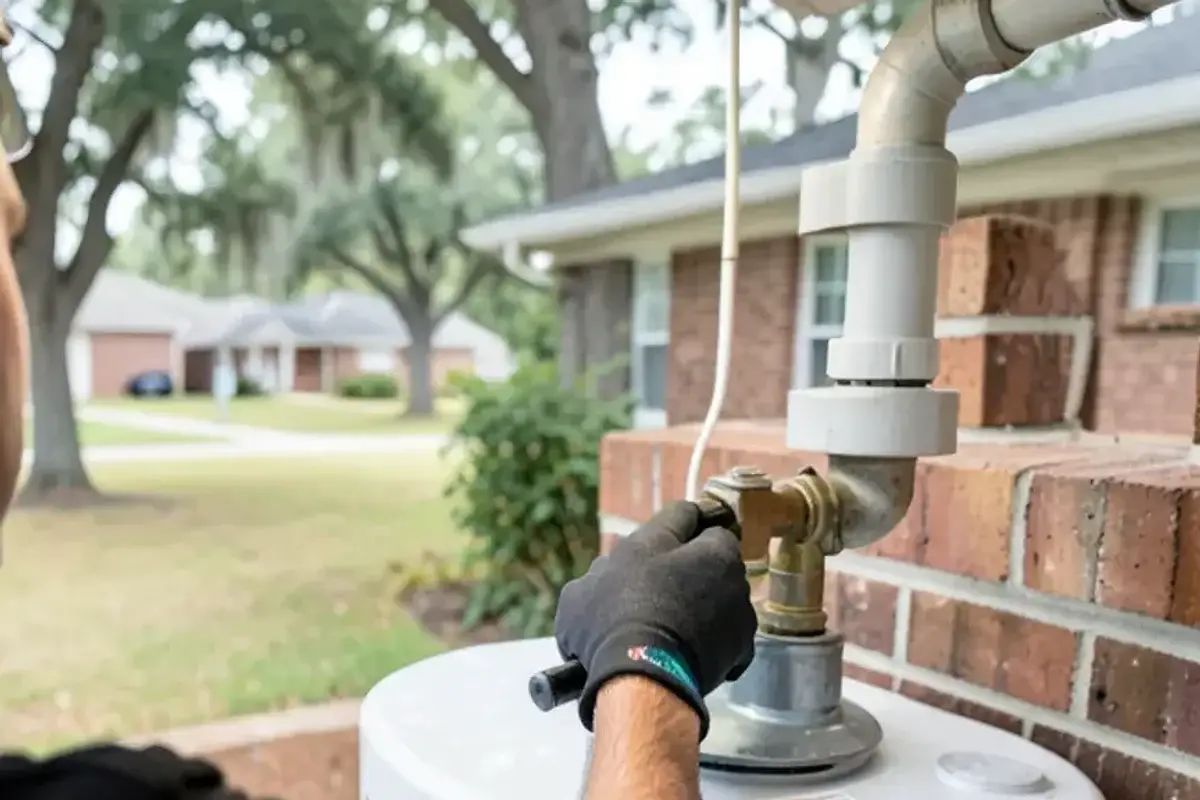
Tank leaking from the bottom? Shut it down, then call.
- ★ 5.0 on Google, 18 reviews
- Sun–Thu 7 AM–8 PM · Fri 7 AM–6 PM · Sat closed
- Clear, upfront quote
Where is the water coming from?
The starting point tells you most of what you need to know. Dry the tank and floor with a towel, then watch for a few minutes with a flashlight.
| Where it starts | Likely cause | How urgent |
|---|---|---|
| Top pipes or fittings | Loose or corroded connection | Soon, and often a repair |
| Relief valve or its pipe | High pressure, high temperature or a worn valve | Soon, and do not cap it |
| Drain valve near the bottom | Worn valve or a loose fit | Soon, and often a repair |
| Under the tank or through the jacket | Corroded tank | Now, plan a replacement |
| Near the burner, then stops | Condensation | Watch it |
| Nearby pipe or appliance | A different leak entirely | Depends on the source |
A dripping relief valve may be doing its job. Wikipedia's water heating overview notes that this valve releases water if temperature or pressure gets too high, and plumbing codes usually require a discharge pipe. Never plug it. A blocked valve removes the tank's main safety release.
Why does a relief valve drip?
Pressure is the usual reason. Water expands as it heats, and on a home with a check valve or pressure reducer at the meter, that extra volume has nowhere to go. Pressure climbs until the valve opens.
Screw a pressure gauge with a peak needle onto a hose bib and leave it for a day. Plumbing codes commonly cap house pressure at 80 psi, so a higher reading calls for a look at the pressure reducing valve, and often an expansion tank. A new relief valve alone leaves the cause in place.
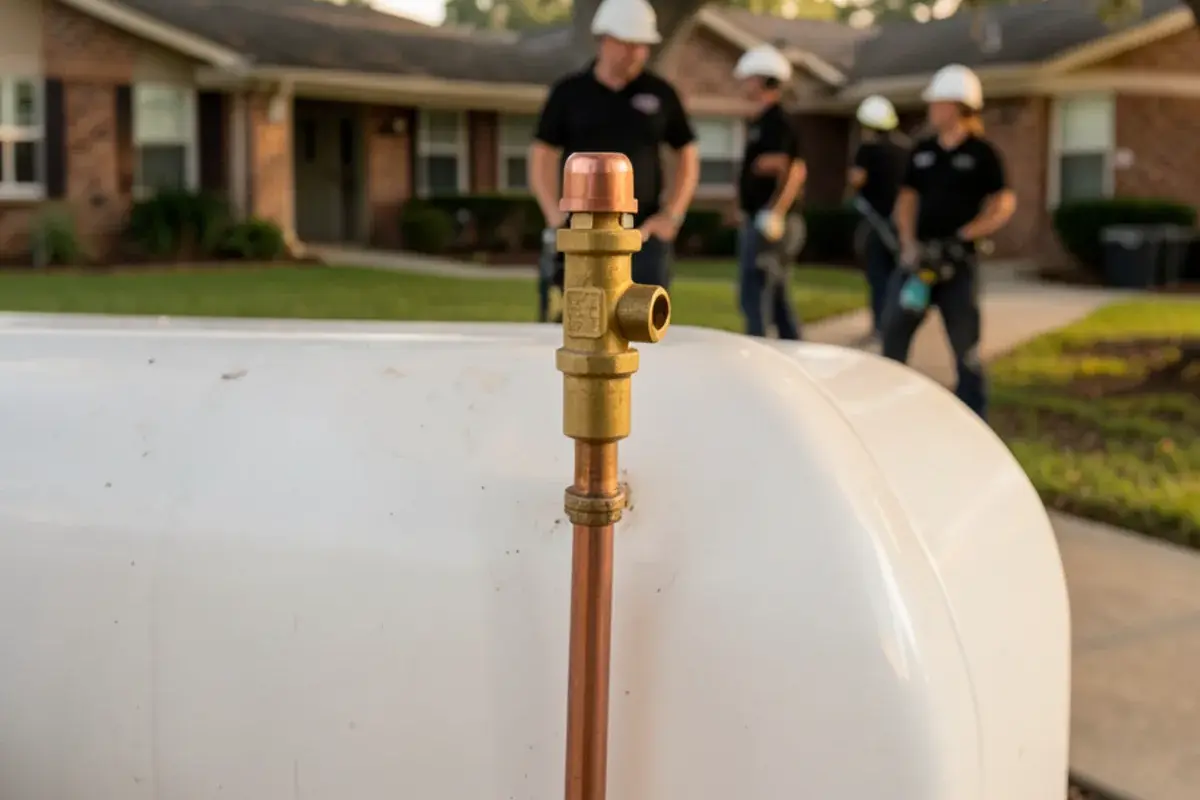
How do you stop a tank from flooding the house?
Draining the tank removes what could still escape. Do this only if the leak is steady and the water has had time to cool.
- Confirm the cold inlet is closed and the energy is off.
- Run a garden hose from the tank's drain fitting to the yard or a floor drain.
- Open a hot water faucet to let air in.
- Open the drain valve slowly.
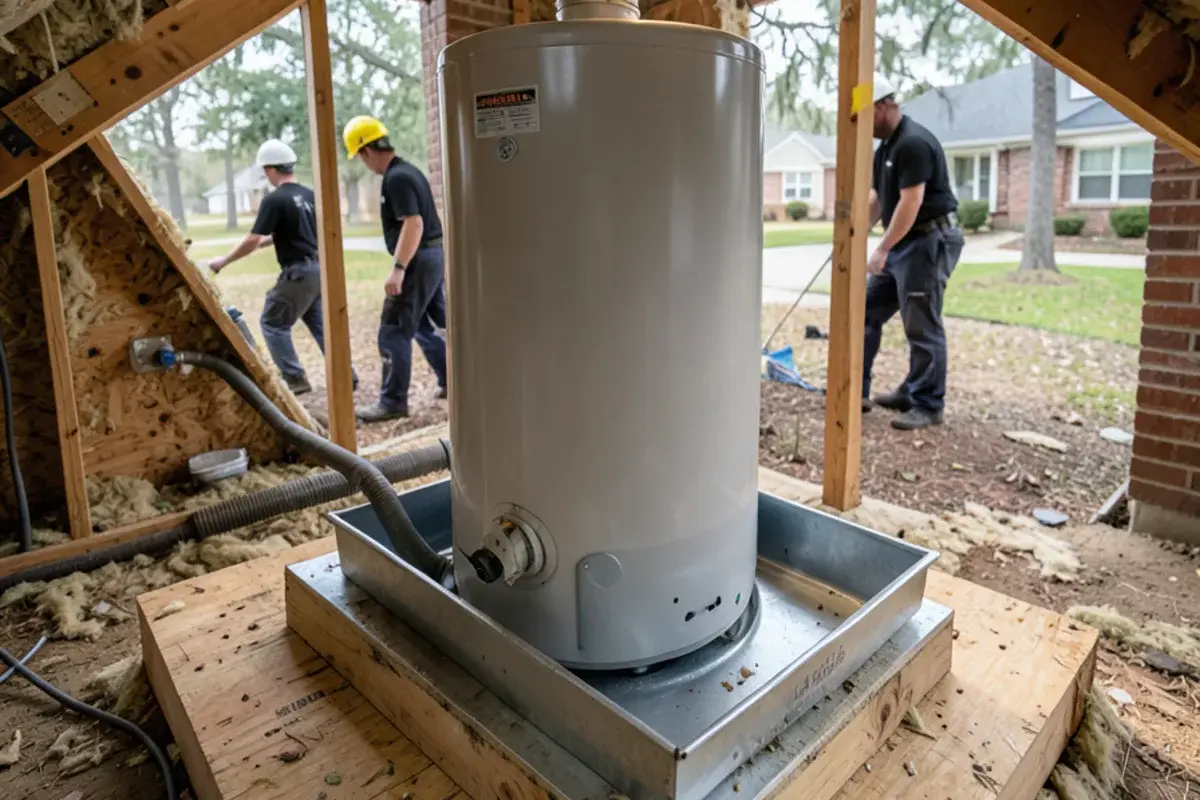
Sediment can block the valve or stop it from sealing again, so leave this step to a plumber if the valve looks corroded. A tank in a garage is a nuisance when it fails. A tank in an attic is a ceiling job, so look at the pan and its drain line now, while it is dry.
What should you check on an attic heater?
A pan only works if its drain does. Check these while the unit is dry:
- The pan sits under the whole tank, with no cracks or rust holes
- A drain line leaves the pan and ends where you would notice water
- That line has no sag, crush or clog
- The platform is solid, with room to reach the valves
Dry the room fast. The EPA advises drying water-damaged materials inside 24 to 48 hours, which is your window to head off mold.
Can a leaking water heater wait until morning?
A leak can wait only if the supply is shut off and the water has stopped spreading. Keep the inlet closed, keep the energy off, and you will simply have no hot water for a while.
Do not restart a heater that has been drained or partly emptied. An electric element can burn out without water around it. A gas burner that got wet needs a look before it runs again.
Check the clock before you call. Sunday through Thursday, PipeElectric picks up from 7 AM to 8 PM. Friday runs 7 AM to 6 PM, and Saturday is closed. If the phones are closed, shut the heater down as above and call when they open. Customers in Pasadena and across Houston can describe the leak on that first call.
Why do tanks start leaking in the first place?
Corrosion ends most tanks. The steel shell has a glass lining, and a sacrificial anode rod takes the rust that would otherwise attack any flaw in it. Once the anode is used up, the steel starts to go, and by the time water reaches the floor the damage has been building for a long time.
Three things speed it up:
- Sediment: it settles on the tank bottom and makes a gas burner overheat the steel below it.
- High pressure: repeated expansion flexes the tank and works at its welds and fittings.
- A high thermostat setting: hotter water speeds corrosion and raises the scald risk.
Water from the tank body is the end of that chain, which is why no repair reverses it.
Our team's take on repairing versus replacing a leaking heater
Our team's general rule is to match the fix to the failed part and the age of the tank.
- Fitting, relief valve or drain valve on a younger unit: a water heater repair usually makes sense.
- Water from the tank body: plan a replacement, since a rusted shell cannot be patched.
- An older unit with a second problem: price a replacement before paying for another repair.
Age sets the odds. An Institute for Business & Home Safety study, as reported by the Connecticut Insurance Department, found the chance of a leak or burst climbs sharply from about year 5, and that three-quarters of water heaters fail before year 12.
Read the serial number on the data label, since many manufacturers code the build date there, and look at the condition of the fittings on top. Rust at the top of the tank often means trouble inside it as well.
Ask whether the replacement needs a drain pan, an expansion tank or a code update. Our water heater installation page covers those choices.
The steps in short
Check for gas, close the cold inlet, cut the energy, then find the source. Bottom-of-tank leaks mean a new heater. Fitting leaks usually mean a repair. Once it is safe, check the hoses and connectors nearby too. Triple-I suggests inspecting water heater hoses every year and replacing them every five to seven years.
Your homeowners policy may treat the water damage and the failed heater differently, so photograph everything and call your insurer before anything is hauled away. For a leak that is not at the heater, see emergency leak repair.
Common questions
Can a leaking water heater tank be repaired?
Not if the tank itself is leaking. Once the steel shell has rusted through, the only real fix is a replacement. Leaks at a fitting, drain valve or relief valve are different, because those parts can usually be repaired or swapped. That is why finding the exact starting point matters before you price anything.
Is condensation on a water heater normal?
It can be, especially on a gas unit after a large draw of cold water. Condensation forms on the cool tank, drips onto the burner and stops once the tank warms up. Wipe the area dry and check again after an hour. If the wet patch keeps growing with the unit at temperature, treat it as a real leak.
Why is my water heater leaking from the bottom?
Most often the tank has rusted through, though a loose drain valve or a relief pipe dripping down the side can look the same. Dry everything, then touch a paper towel to the drain valve and follow the relief pipe. If both stay dry and water keeps appearing under the jacket, keep the inlet closed and plan for a replacement.
Is a leaking water heater dangerous?
It can be, and the risk depends on the fuel and the location. Water reaching a gas burner can put out the flame or damage the control. Water near an electric unit's wiring or a garage outlet raises a shock risk. The stored water can also scald, which is why the energy goes off before you touch any fitting or drain valve.
Water around the base of the tank? Call and describe where it starts.
- ★ 5.0 on Google, 18 reviews
- Sun–Thu 7 AM–8 PM · Fri 7 AM–6 PM · Sat closed
- Clear, upfront quote
Written by the PipeElectric team
PipeElectric is a Houston plumbing company with 18 Google reviews and a 5.0 rating. Read about us.